ISO 11357-3:2025: Practical DSC Reporting Checklist
 testDSC.Admin
ISO 11357-3:2025 is the fourth edition for measuring melting and crystallization temperatures and enthalpies in crystalline and partially crystalline plastics by conventional DSC. ISO’s current page lists it as published in May 2025. The standard excludes fast DSC, which ISO 23976 covers.
The practical change is replacing ISO 11357-3:2018 with an order-ready and report-ready workflow. LabCoda’s PN-EN ISO 11357-3 summary identifies useful points for sample mass, nitrogen purge, heating rates, thermal cycles, peak temperatures, baseline, enthalpy, and Clause 12 reporting. Verify every clause against the licensed 2025 text because LabCoda flags some detailed procedure language as inherited from 2018.
What changed in ISO 11357-3:2025?
ISO 11357-3:2025 is Edition 4, published in May 2025, and it replaces ISO 11357-3:2018 for conventional DSC testing of crystalline and partially crystalline plastics. The scope is specific: determine melting and crystallization temperatures and enthalpies under controlled thermal conditions.
Does ISO 11357-3:2025 cover fast DSC?
No. ISO 11357-3:2025 excludes fast DSC. Fast DSC falls under ISO 23976, so your purchase order should identify conventional DSC when this standard is requested.
The edition update does not require a generic review of the entire ISO 11357 series. It requires you to identify the applicable 2025 procedure, record the actual thermal program, and receive a report that connects Tm, Tc, and ΔH to the measured baseline and test conditions.
What should you specify when ordering an ISO 11357-3 DSC test?
Your test request should identify the polymer, sample history, requested thermal cycle, atmosphere, heating and cooling rates, and report outputs. For a practical ISO 11357-3 DSC order, specify these fields before the sample reaches the laboratory.
| Order field | Practical specification | Use when |
|---|---|---|
| Sample mass | Preferably 5–10 mg under Clause 9.2 | You need comparable enthalpy values across samples |
| Purge | Nitrogen pre-purge for 5 minutes under the LabCoda summary of Clause 9.4 | You need a defined starting atmosphere |
| Heating rate | Prefer 10 or 20 K/min, numerically equivalent to 10 or 20 °C/min | You need a reproducible Tm and ΔH measurement |
| Thermal cycle | First heating, cooling, and second heating; first heating reaches approximately 30 K above the extrapolated end of melting | You need to separate received history from controlled reheating |
| Failure mode | Baseline drift, pan mismatch, or incomplete purge can distort peaks and ΔH | The curve shows unstable baseline, shifted peaks, or unexplained shoulders |
Record the actual sample mass rather than only the target mass. A nominal 10 mg request is not a measured result. The report should show the mass used for enthalpy normalization and identify any deviation from the requested range.
See also: DSC test
How does TestDSC run the measurement?
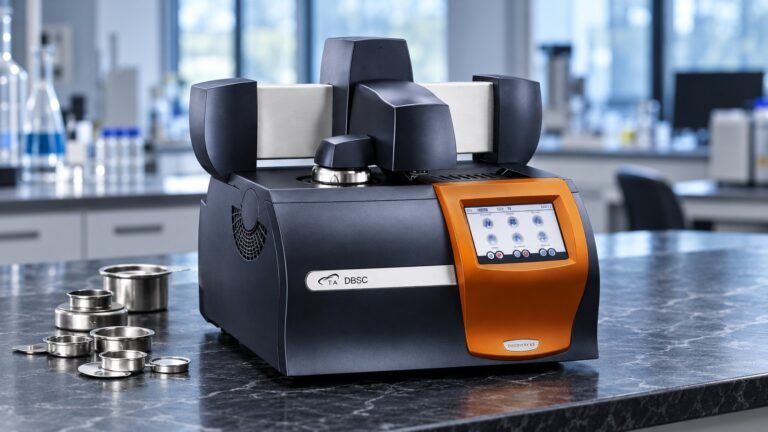
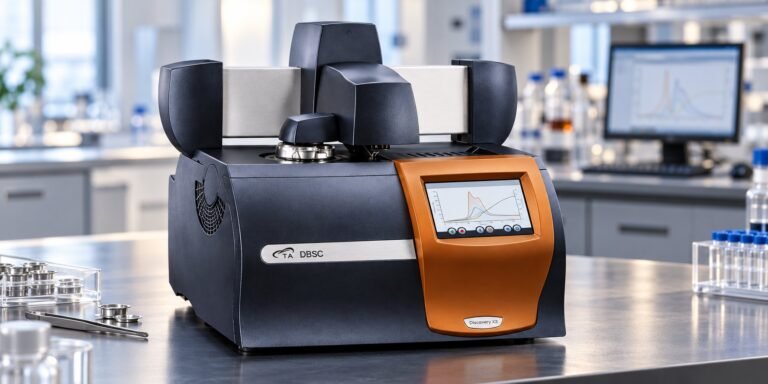
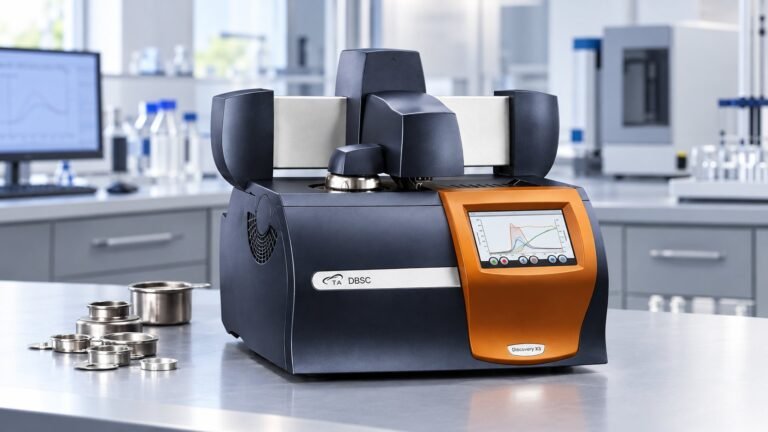
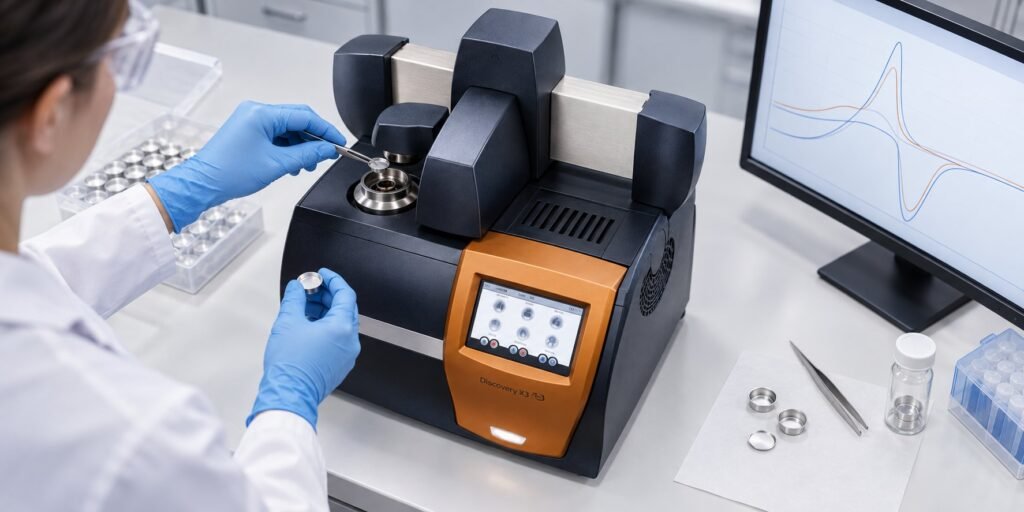
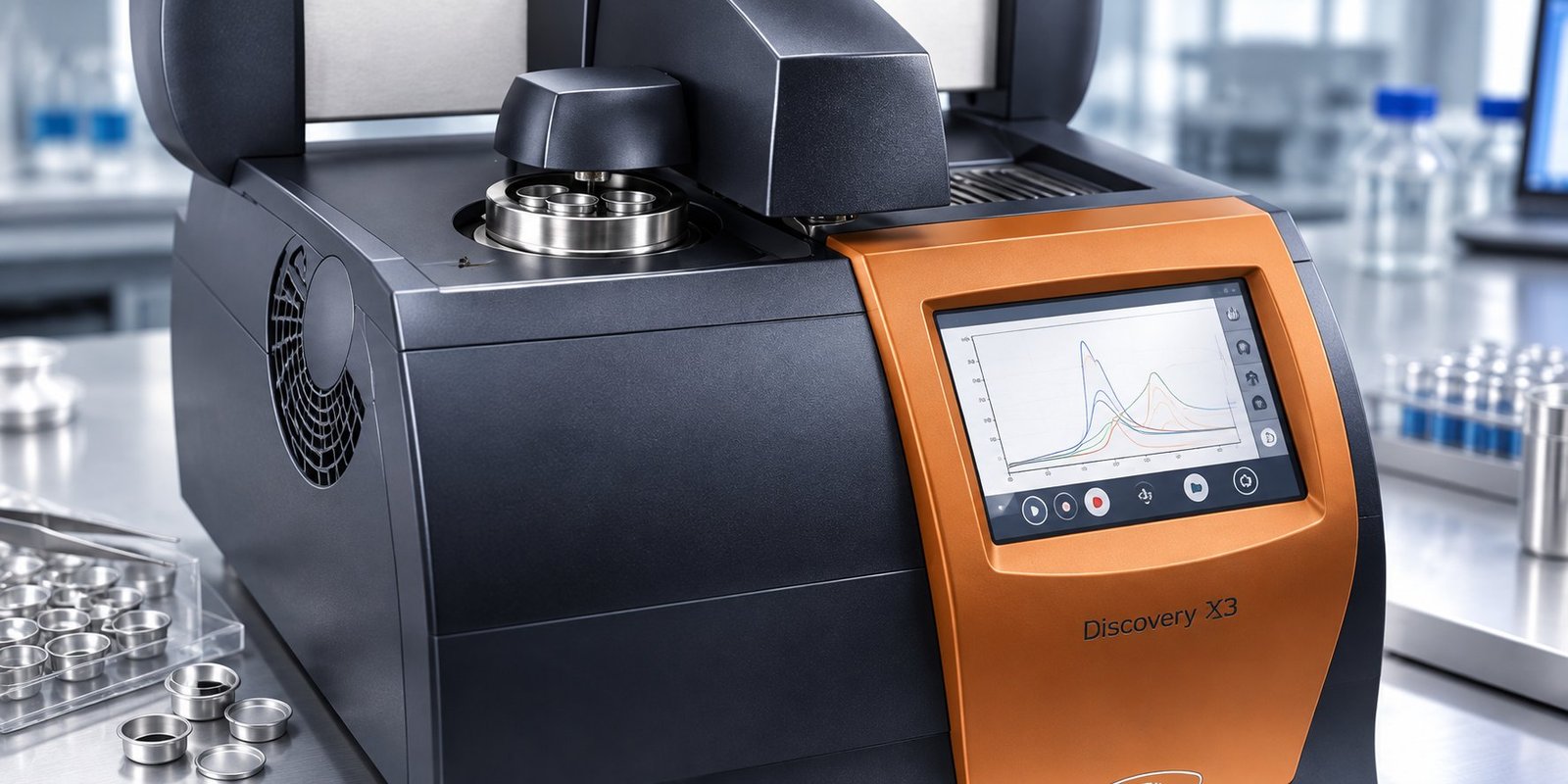
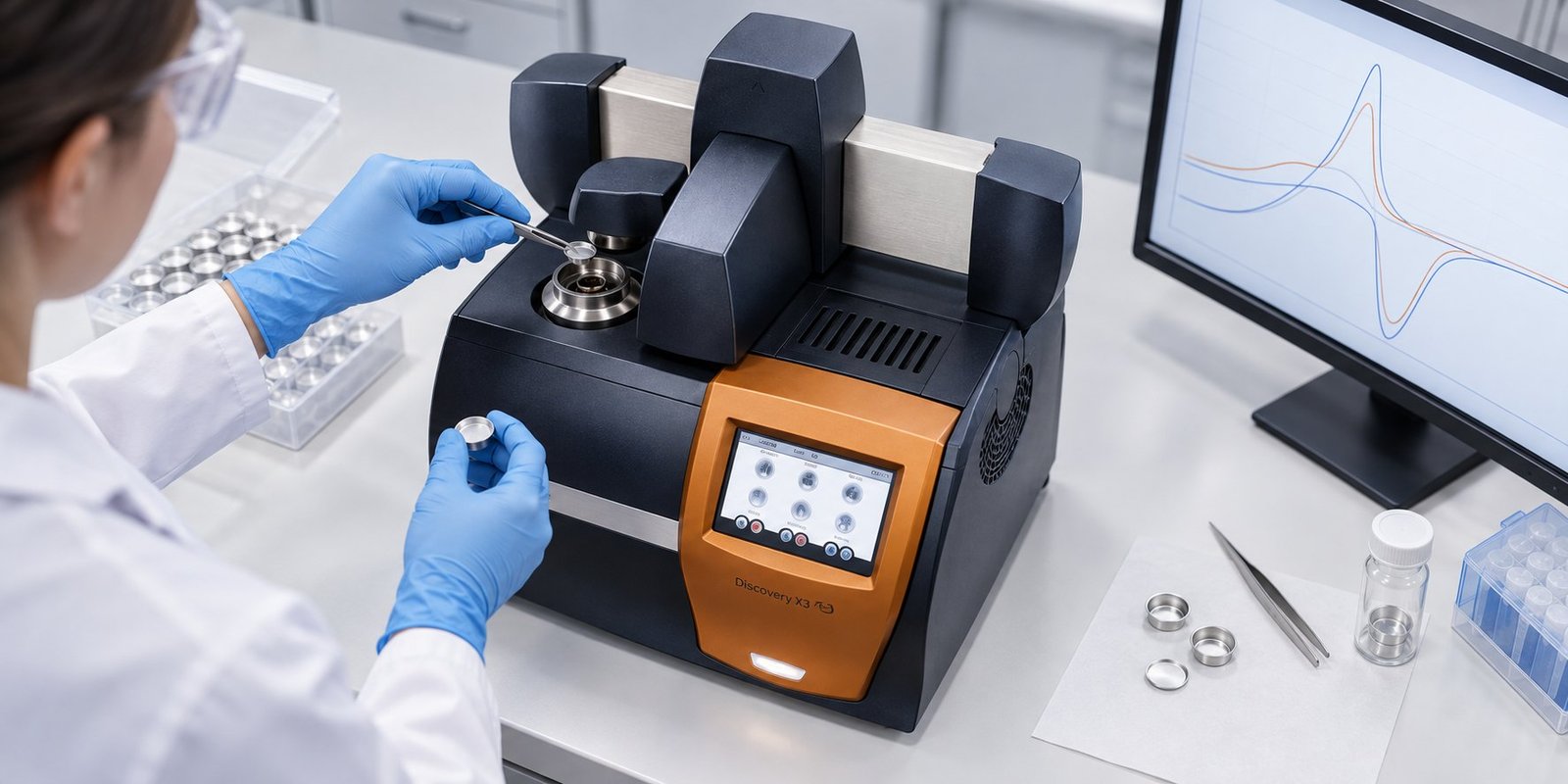
TestDSC runs conventional DSC on customer-supplied polymer samples using a TA Instruments Discovery X3 over -160 °C to 400 °C. We record sample mass, heating and cooling rates, Tm, Tc, and ΔH, then review the curve for baseline and peak behavior before reporting.
- 1. Receive and identify the sample. We record the customer sample designation and measured mass. Misidentification or an unrecorded mass prevents traceable ΔH reporting.
- 2. Establish the purge. We apply the specified nitrogen pre-purge and record the condition. Residual air can create oxidation-related drift or an extra exothermic feature.
- 3. Run the first heating. We heat at the requested rate, commonly 10 or 20 °C/min, to approximately 30 °C above the extrapolated end of melting. An insufficient endpoint can leave melting incomplete.
- 4. Cool and run the second heating. The cooling and second-heating curves expose thermal history and recrystallization behavior. Poor pan contact or an uncontrolled cooling segment can shift Tc.
- 5. Review and report. We record Tm, Tc, ΔH, baseline behavior, mass, rates, and thermal limits. A drifting baseline or overlapping transition is flagged rather than treated as a clean single peak.
One anonymized measured result in the TestDSC lab log shows Tm 164.7 °C, Tc 126.2 °C, and ΔH 48.3 J/g for a customer-supplied polymer run at 10 °C/min. The values are meaningful only with the sample mass, nitrogen condition, thermal cycle, and baseline included.
What must polymer DSC reporting contain under the 2025 edition?
Polymer DSC reporting should connect each reported transition to its measurement conditions. Clause 10.1 covers peak temperatures and baseline treatment, Clause 10.2 covers enthalpy in kJ/kg or J/g, and Clause 12 defines the report contents to provide.
| Report field | Report-ready entry | Why you need it |
|---|---|---|
| Peak temperatures | Tm and Tc in °C, with the evaluated peak or baseline method identified | You can compare transitions between lots and thermal cycles |
| Baseline | Baseline placement and any curve feature affecting evaluation | You can distinguish a measured transition from drift or overlap |
| Enthalpy | ΔH in J/g or kJ/kg, linked to the recorded sample mass | You can compare normalized heat effects |
| Test conditions | Atmosphere, pre-purge, heating and cooling rates, temperature limits, and cycle sequence | You can reproduce the measurement |
| Sample details | Customer designation, sample mass, pan information, and relevant conditioning | You can trace the result to the submitted material |
If you need a short explanation of the measured signal before reviewing the report, our dsc analyse reference explains the instrument output. For an ISO 11357-3 request, the report still needs the edition-specific fields above rather than only a general curve image.
See also: differential scanning calorimetry dsc analysis
How should you verify a 2025-compliant DSC report?
Verify the report against the licensed ISO 11357-3:2025 text, not against a summary alone. LabCoda’s page, reviewed in October 2026, is useful for practical ordering points, but it identifies some detailed procedure text as inherited from ISO 11357-3:2018.
- Confirm that the report names ISO 11357-3:2025 and conventional DSC.
- Check that the measured sample mass is stated in mg.
- Check nitrogen pre-purge time and atmosphere.
- Check heating and cooling rates in K/min or °C/min.
- Check that first heating, cooling, and second heating are identified.
- Check Tm, Tc, and ΔH units.
- Check baseline treatment and any overlapping or ambiguous peaks.
- Check Clause 12 report details against your licensed copy of the standard.
Cooling calibration deserves separate attention when Tc is central to your decision. Our dsc analyse article is the relevant next reference if your result depends on crystallization temperature rather than melting temperature alone.
What can cause false or ambiguous DSC peaks?
False or ambiguous DSC peaks usually follow from baseline instability, poor pan contact, residual oxygen, unsuitable sample mass, or overlapping thermal events. A peak should be investigated when its position changes unexpectedly, its baseline is unstable, or the same feature fails to reproduce on the second heating.
For a focused review of artifacts, see DSC Test False Peaks: Artifact or Real Transition?. For help distinguishing endothermic and exothermic features, use Exothermic and Endothermic Reactions in DSC: What the Peaks Tell You.
Do not substitute an oxidation-induction request for an ISO 11357-3 melting or crystallization test. If oxidative stability is the actual question, the neighboring method discussion identifies astm d3895 as the relevant ASTM reference.
ISO 11357-3:2025 FAQ
What sample mass does ISO 11357-3 DSC prefer?
Clause 9.2 is summarized as preferring 5–10 mg. Your laboratory should confirm the licensed 2025 wording and record the actual mass used.
Which enthalpy units should the report use?
Clause 10.2 identifies kJ/kg or J/g. The report should connect ΔH to the measured sample mass.
Does the standard require a second heating?
The practical workflow summarized by LabCoda includes cooling and second heating. Confirm the exact sequence and conditions against the licensed ISO 11357-3:2025 text.
What should you do before placing the test order?
State ISO 11357-3:2025, identify the polymer and thermal history, and request the measured mass, purge, rates, thermal cycle, Tm, Tc, ΔH, baseline, and Clause 12 report details. Review our DSC thermal analysis and testing services before sending your customer-supplied sample →