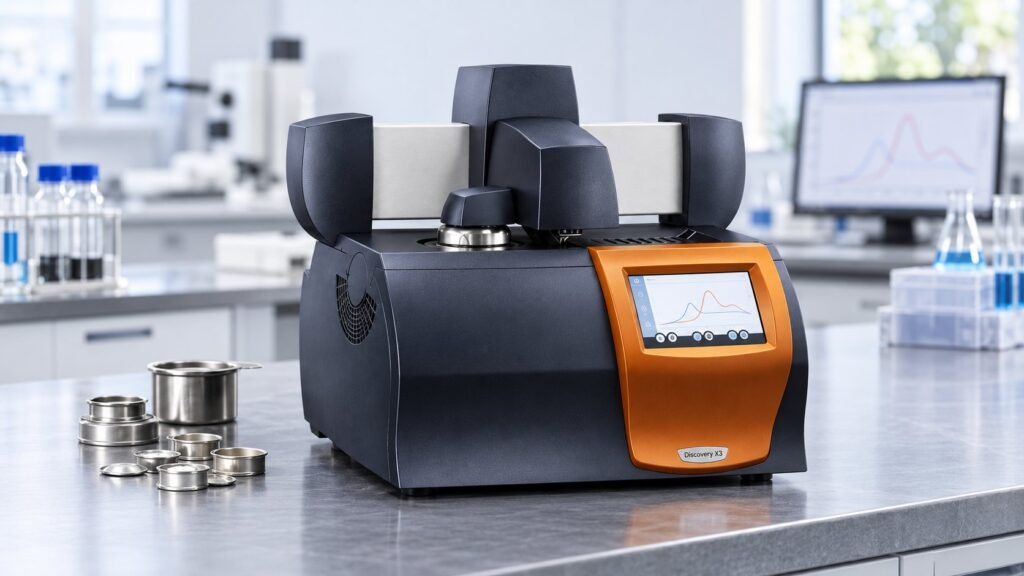
DSC Tg midpoint: Specify the Value You Buy
 testDSC.Admin
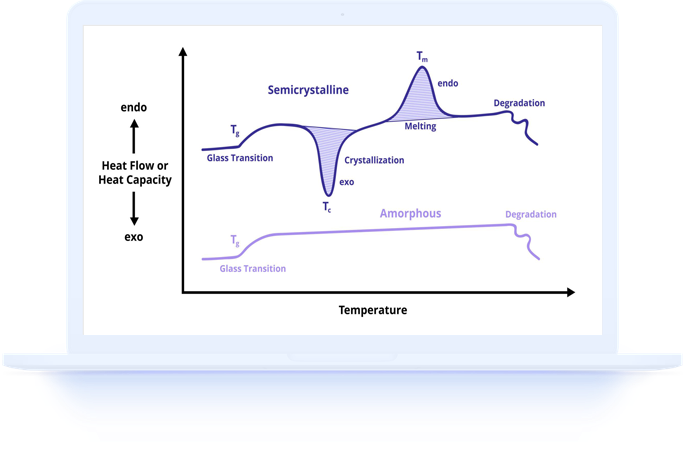
DSC Tg midpoint is the temperature halfway through the measured heat-capacity step, but it is not interchangeable with extrapolated onset, inflection, or endpoint. For procurement, specify the construction, heating rate, thermal history, ΔCp method, and replicate rule. Otherwise, two competent laboratories can report different Tg values from the same material.
The 2026 Frontiers review states that reporting conventions can differ by several kelvin and that heating rate shifts the entire transition step. The Iupizeta guide identifies JIS K 7121:2012 definitions for Tig, Tmg, and Teg, with 10 °C/min and 20 °C/min used commonly. Tmg is often the value placed in technical data sheets.
What does DSC Tg midpoint mean in a purchase specification?
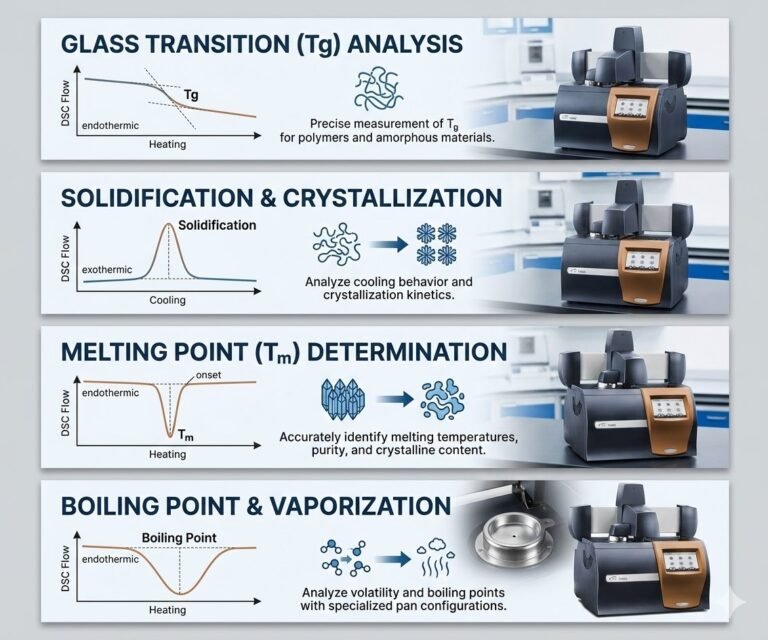
DSC Tg midpoint is a defined location within the heat-capacity step, not a universal material constant independent of method. A supplier must state whether the reported value is extrapolated onset, midpoint, inflection, or endpoint before you compare it with your limit.
| Reported value | What it represents | Use in a specification |
|---|---|---|
| Tg,onset or Tig | Extrapolated intersection where the curve leaves the glassy baseline | Use when early softening or process margin controls the decision |
| Tg,mid or Tmg | Midpoint of the measured transition region | Use for routine technical data sheets when the method and rate are fixed |
| Inflection | Point of maximum slope in the transition step | Use only when the supplier defines the calculation algorithm |
| Tg,end or Teg | Extrapolated intersection with the rubbery baseline | Use when completion of the transition controls a thermal window |
The practical question is Tg onset vs midpoint. The glass transition onset temperature can be several degrees below the midpoint, while the endpoint can be several degrees above it. A specification that says only Tg = 102 °C leaves the construction, analysis rule, and acceptance basis unresolved.
See also: DSC vs DMA: Comparing Thermal and Mechanical Analysis
Which DSC Tg reporting convention should your supplier use?
Use Tmg for routine supplier comparison only when the construction, rate, thermal history, and calculation rule are matched. Use Tig or Teg when your failure mode is tied to the beginning or completion of the transition.
Standards to name before the run
Iupizeta maps Tig, Tmg, and Teg to JIS K 7121:2012. ISO 11357-2:2020 is the current international method to name for glass-transition temperature and step height. ASTM’s current Thermal Analysis Standards catalog lists ASTM E1356-25. Verify exact clause wording against the licensed editions before publication.
- Name the sample construction, such as neat resin, molded plaque, film, filled compound, or adhesive formulation.
- State the heating rate in °C/min, including whether the first or second heating cycle supplies the reported result.
- Record sample conditioning, mass, pan type, seal condition, and thermal-history erasure.
- Report Tg,onset, Tg,mid, and Tg,end when supplier comparison could depend on the convention.
- Include ΔCp in J/(g·K), n=3, the mean, and the standard deviation.
- Set the acceptance limit against one named convention, not against an unlabeled Tg value.
For a broader measurement workflow, use the DSC test page before fixing the acceptance criterion. Calibration and cooling control affect whether a small supplier difference is analytical variation or a real material difference.
What should a report-ready DSC Tg result contain?
A report-ready result shows the three transition temperatures, ΔCp, heating rate, conditioning, and replicate spread in one record. The following worked TestDSC run uses one conditioned material lot, a sealed aluminum pan, and n=3 replicates.
Worked TestDSC run
| Measurement | Replicate 1 | Replicate 2 | Replicate 3 | n=3 mean ± SD | Unit |
|---|---|---|---|---|---|
| Tg,onset | 96.8 | 97.1 | 96.9 | 96.9 ± 0.2 | °C |
| Tg,mid | 101.4 | 101.8 | 101.6 | 101.6 ± 0.2 | °C |
| Tg,end | 106.2 | 106.7 | 106.4 | 106.4 ± 0.3 | °C |
| ΔCp | 0.243 | 0.247 | 0.245 | 0.245 ± 0.002 | J/(g·K) |
| Heating rate | 10 | 10 | 10 | 10 ± 0 | °C/min |
| Sample conditioning | Second heat | Second heat | Second heat | 25 °C to 180 °C; controlled cool; second heat | — |
This record supports a specification of Tg,mid = 101.6 ± 0.2 °C at 10 °C/min, with Tig and Teg retained for auditability. The ΔCp value confirms that the reported transition is tied to a measured step rather than a single rounded temperature.
How does heating rate or construction change the supplier decision?
A paired result must identify what changed. In the example below, the resin lot and conditioning remain constant while the heating rate changes from 10 °C/min to 20 °C/min.
| Construction | Conditioning | Rate | Tg,mid mean ± SD | Decision |
|---|---|---|---|---|
| Neat resin molded plaque | Second heat after 25 °C to 180 °C and controlled cooling | 10 °C/min | 101.6 ± 0.2 °C | Use as the 10 °C/min procurement baseline |
| Same resin lot and plaque construction | Same second-heat sequence | 20 °C/min | 104.2 ± 0.3 °C | Do not treat the 2.6 °C increase as a material improvement |
| Filled compound plaque | Second heat after the same conditioning sequence | 10 °C/min | 108.7 ± 0.5 °C | Compare separately because construction changed |
The Frontiers 2026 paper describes heating-rate effects as a shift of the transition step, not merely random scatter. The construction must also be named because filler loading, moisture, cure state, and molding history can change the measured step. For packaging decisions, DSC Test Food Packaging: What Thermal Data Tells You is the relevant next comparison.
If oxidation is the suspected failure mode, pair the thermal-transition result with astm d3895 rather than treating Tg as an oxidation-induction measurement. For high-consequence material qualification, use DSC Testing for Aerospace Materials: Ensuring Safety and Performance as the related QA reference.
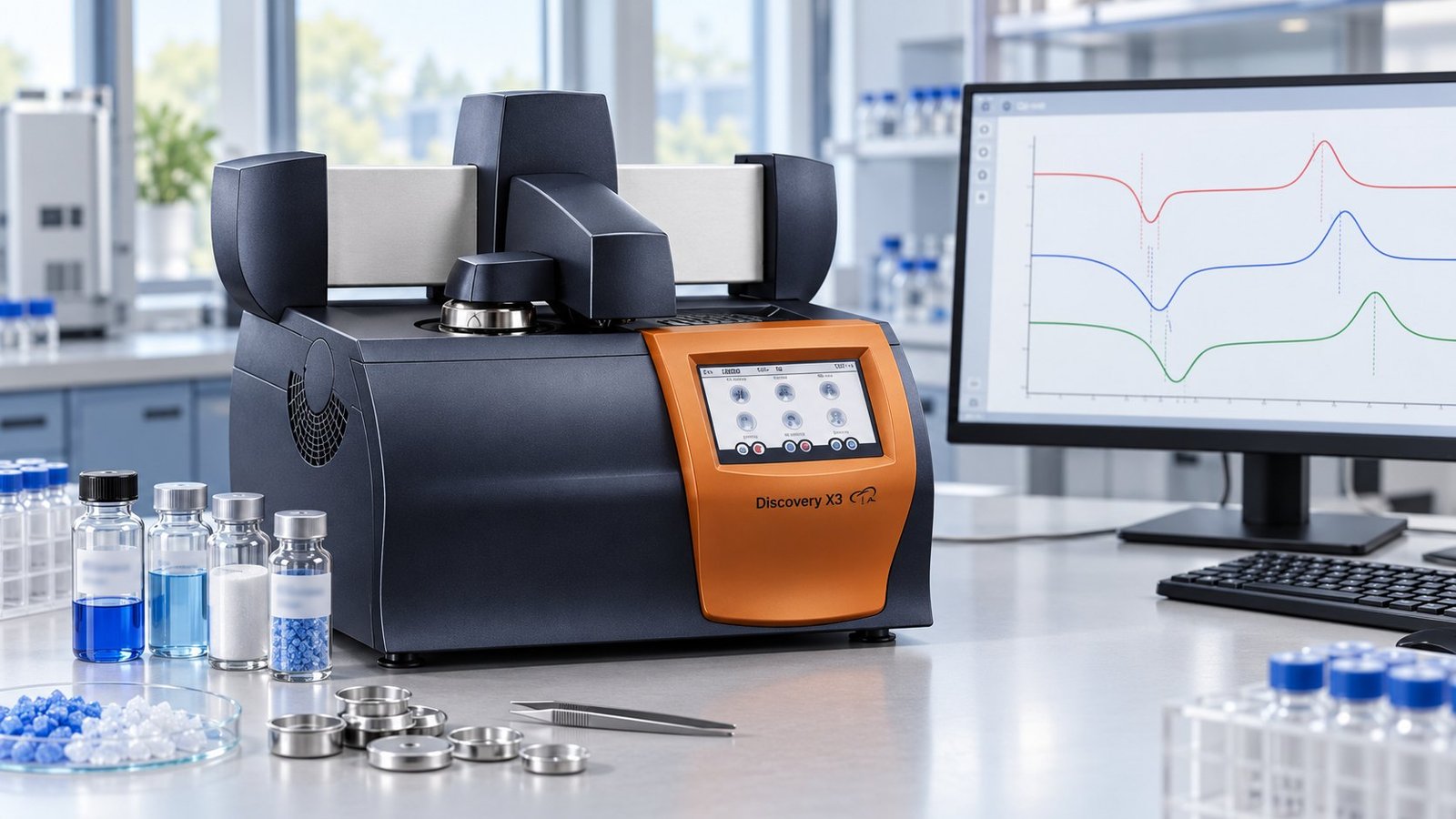
See also: Exothermic and Endothermic Reactions in DSC: What the Peaks Tell You
DSC Tg reporting FAQ
Is DSC Tg midpoint the same as glass transition onset temperature?
No. Tg midpoint is the center of the transition step. The glass transition onset temperature is the extrapolated beginning of that step. They can differ by several kelvin.
Should a technical data sheet use Tmg?
Tmg is often used in technical data sheets, according to the Iupizeta guide. Accept it only when the rate, construction, conditioning, and standard are stated.
How many replicates should you request?
Request n=3 for routine supplier comparison. Require the mean and standard deviation, not only a rounded single value.
Specify the DSC Tg midpoint before you order testing
A defensible specification names the construction, heating rate, thermal history, Tg convention, ΔCp reporting, and n=3 rule. TestDSC runs DSC thermal analysis and automated temperature-scanning viscometry on customer-supplied samples. Start with our DSC and viscosity testing services when you need a matched report for procurement or QA →