High Viscosity Meaning: How to Classify It
 testDSC.Admin
High viscosity meaning is strong resistance to flow, not a universal numeric classification. A liquid is “high” only relative to its temperature, viscosity type, method, and application. ASTM D7483-26 spans 0.2–20,000 mPa·s, but that operating envelope does not make 20,000 mPa·s the definition of high viscosity.
BÜHNEN and Learn Physics currently ranking for this phrase use slow-flow examples such as honey, glycerine, and water. That explanation is useful but incomplete for R&D or QC. The technical answer is a reporting framework: state the unit, viscosity measurement temperature, method, and application limit before calling your sample high.
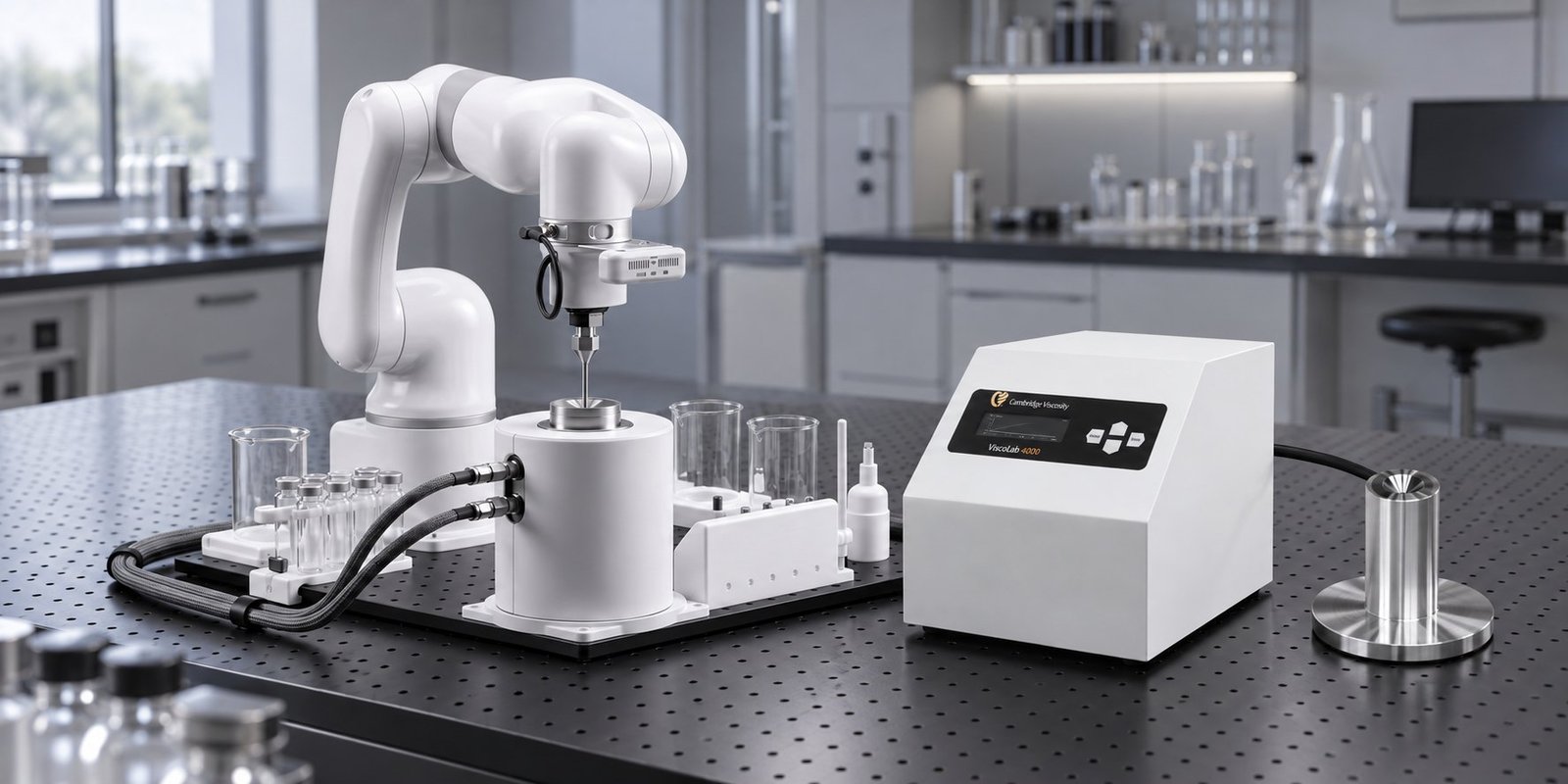
What is the high viscosity meaning in a report?
The high viscosity meaning in a report is a condition-specific statement: the sample resists flow strongly under named conditions. It is not a universal cutoff that applies across every liquid, temperature, instrument, or application.
BÜHNEN describes highly viscous material through lower flow ability and slower spreading. Learn Physics explains the behavior through resistance between moving fluid layers, using honey and glycerine as familiar examples. Those sources establish the direction of the behavior, not a numeric class.
Your result becomes useful when you bind it to viscosity type, unit, temperature, and method. If your specification uses the phrase high viscosity in cP, keep the temperature and procedure beside the value. For the cP-to-cSt distinction, use our high viscosity vs low viscosity comparison before interpreting the number →
See also: Viscosity in synthesis and mixing: monitoring blends and reactions
Does ASTM D7483-26 define high viscosity?
ASTM D7483-26 does not define a universal high-viscosity threshold. Sections 1.1–1.4 describe an operating scope of 0.2–20,000 mPa·s over −40 °C to 190 °C.
| ASTM D7483-26 condition | Reported range | What it means |
|---|---|---|
| Overall operating envelope | 0.2–20,000 mPa·s; −40 °C to 190 °C | Method scope, not a high-viscosity cutoff |
| Precision evidence at 40 °C | 34–1,150 mPa·s | Evidence is narrower than the full envelope |
| Precision evidence at 100 °C | 5.7–131 mPa·s | Temperature-specific evidence; do not generalize to 20,000 mPa·s |
The distinction matters because 20,000 mPa·s is an operating boundary within the standard’s stated scope. It is not a universal definition of high viscosity. The precision evidence cited at 40 °C and 100 °C covers narrower ranges, so you should not infer identical performance across the full envelope.
A high viscosity mPa·s result should be written as a value with its temperature and method, such as 413.1 mPa·s at 20 °C. The unit alone cannot tell you whether the result is high for your process.
Why do temperature and application change the number?
Temperature and application change what counts as high because viscosity is a measured property, not a fixed label. The viscosity measurement temperature belongs beside the result, not in a separate footnote.
ISO 9200:2024 Section 4.5 provides an application example. It discusses viscous hydrocarbon measurement above 100 and below 2,000 mm²/s, while residual fuels may exceed 750 mm²/s at 50 °C. Those values describe an application context, not a universal boundary for every material.
- Viscosity type — identify dynamic or kinematic viscosity before comparing values.
- Temperature — record the setpoint, such as 20 °C, 40 °C, 50 °C, or 100 °C.
- Application limit — state the process or standard boundary that makes the result high for your use.
If your result belongs at the lower end of a reporting range, the related low viscosity meaning article covers that separate case. It should not be used to set a high-viscosity threshold.
How does TestDSC measure and report high viscosity?
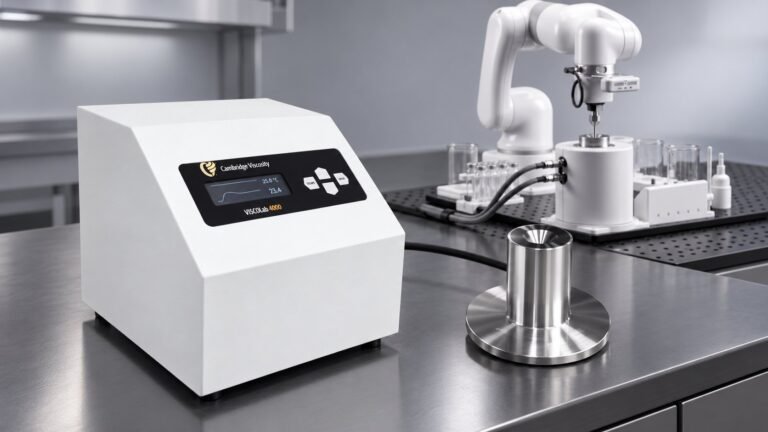
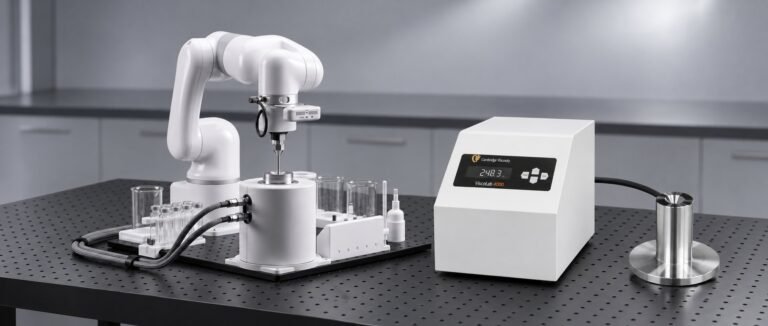
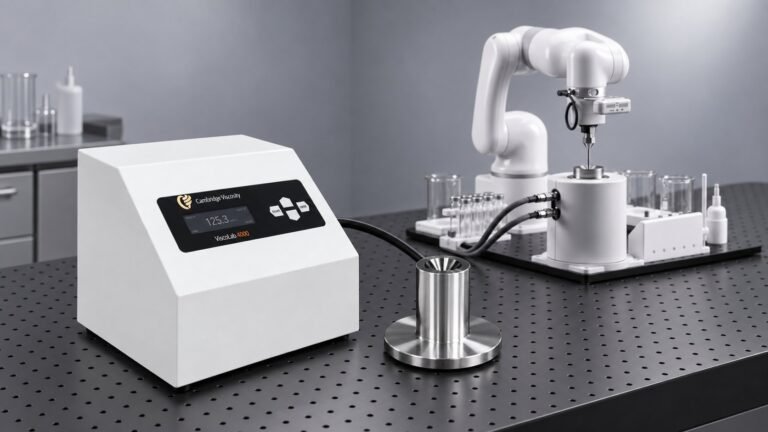
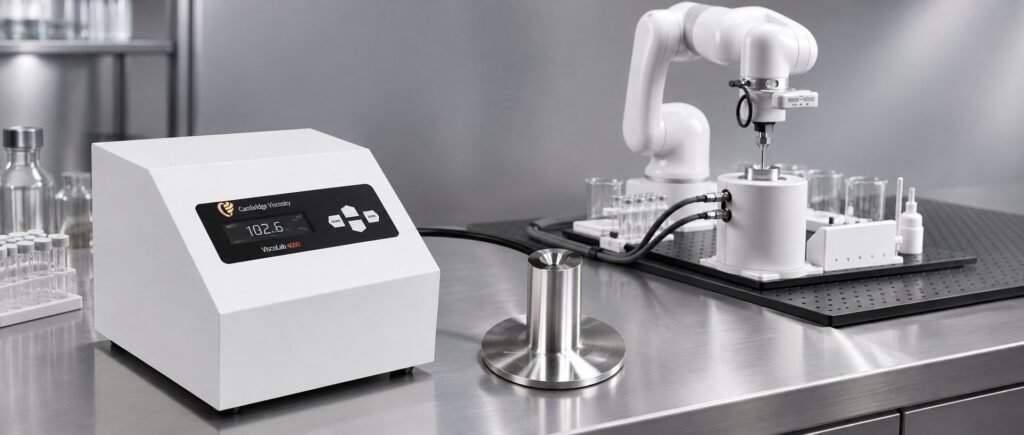
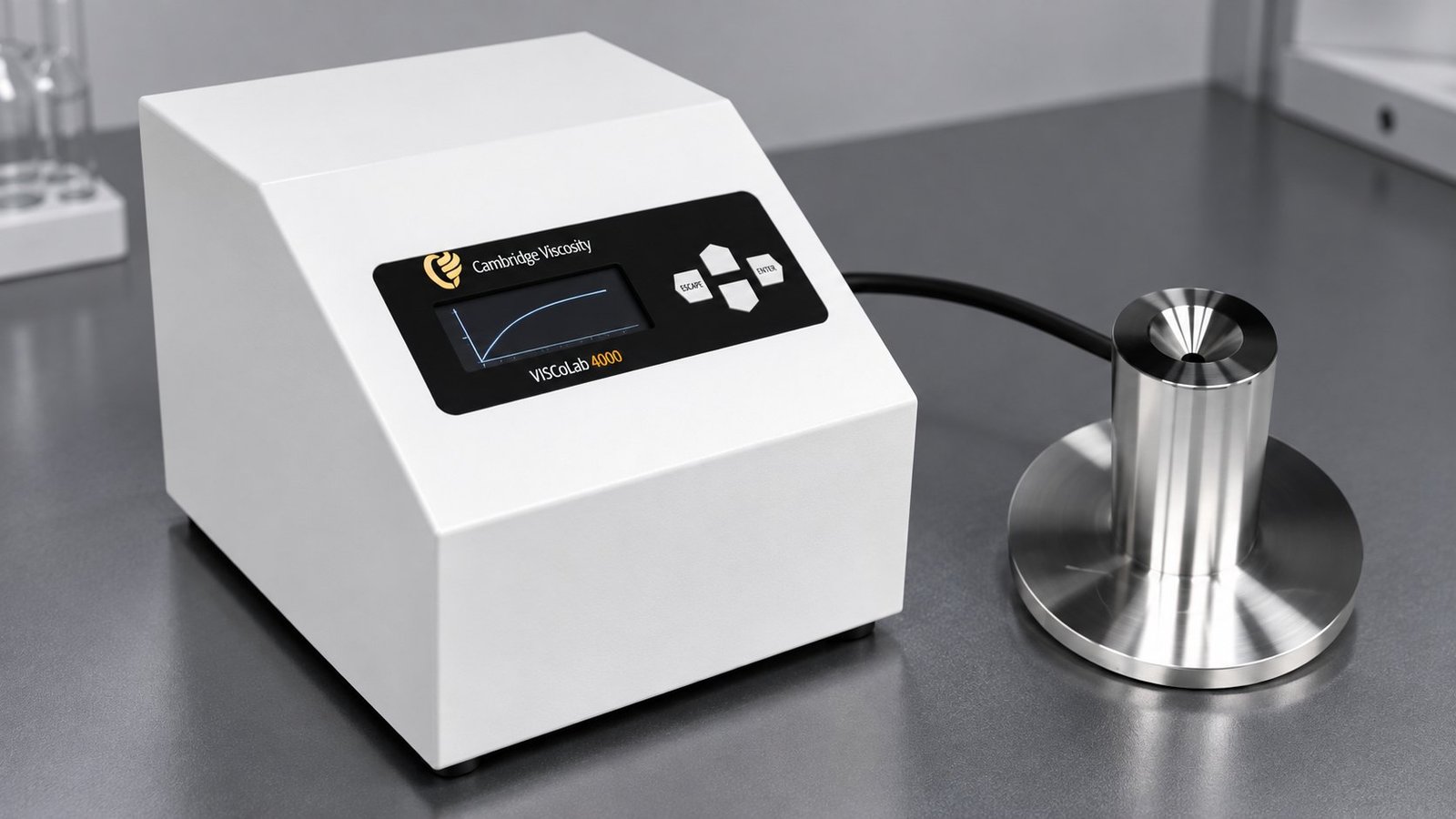
TestDSC uses a Cambridge VISCOlab 3000 for dynamic-viscosity work across 0.1–20,000 cP, with controlled setpoints from −30 °C to +40 °C in 0.1 °C increments. The useful output is the repeat result under a stated temperature, not a bare label.
In an anonymized repeat result, readings were 412.6 and 413.1 mPa·s at 20 °C, then 188.4 and 188.7 mPa·s at 40 °C. The difference shows why temperature belongs in the result. At 20 °C, the sample resists flow more strongly under this measurement.
The failure mode is calling a sample high without temperature, unit, method, or application limit. That label cannot be compared, repeated, or used reliably for a process decision.
- Set the viscosity type and unit — report dynamic viscosity in cP or mPa·s; failure mode: comparing a dynamic value with a kinematic limit.
- Record the viscosity measurement temperature — include the setpoint, such as 20 °C or 40 °C; failure mode: treating 412.6 mPa·s at 20 °C as interchangeable with 188.4 mPa·s at 40 °C.
- Name the method and instrument — for example, Cambridge VISCOlab 3000; failure mode: combining results from unmatched procedures.
- State the application limit — identify the process or standard boundary; failure mode: calling 20,000 mPa·s a universal threshold.
For sample-fit decisions, review TestDSC’s viscosity test method guide before submitting a sample →
See also: Automated viscosity measurement: more data, less variance
FAQ: high viscosity meaning in practice
High viscosity is always a condition-specific result. These answers address the reporting questions that most often cause comparison errors.
Is 20,000 mPa·s always high viscosity?
No. ASTM D7483-26 Sections 1.1–1.4 place 20,000 mPa·s within an operating envelope. They do not establish it as a universal definition.
What temperature should accompany the result?
Report the actual viscosity measurement temperature, such as 20 °C, 40 °C, 50 °C, or 100 °C. A value without temperature is incomplete.
What should a high-viscosity request include?
Include the sample identity, viscosity type, unit, temperature, method, instrument range, and application limit. Those details determine whether the result answers your specification.
How should you report a high-viscosity result?
A defensible high-viscosity result pairs the value with viscosity type, unit, temperature, method, and application limit. At TestDSC, DSC admin uses that framework for customer-supplied samples. Request automated viscosity testing with temperature control →