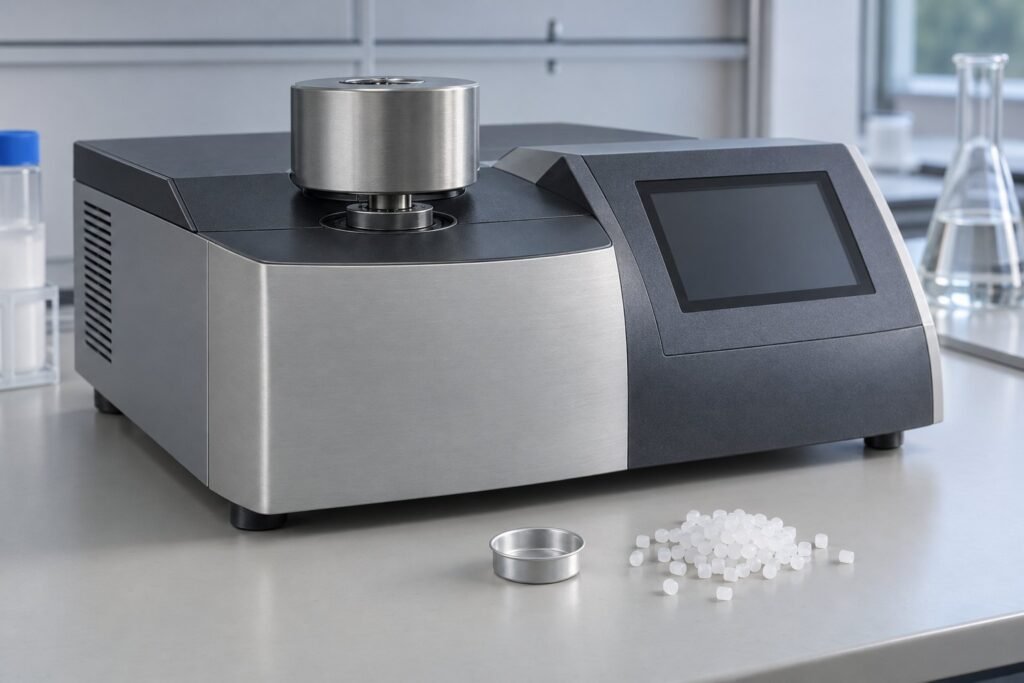
DSC Test Short Chain Branching: What It Shows
 testDSC.Admin
Yes. A DSC test short chain branching result can estimate the distribution in semicrystalline ethylene/1-olefin copolymers when you use successive self-nucleation and annealing (SSA). ISO 18177:2025 derives branching content, degree of branching, crystallinity, and branching distribution from multiple melting peaks. The estimate covers the crystallizable fraction, not highly branched material that does not crystallize.
For a polyethylene producer, the buyer decision is method scope and reporting discipline. Specify the copolymer family, DSC class, sample preparation, complete SSA program, replicate data, and compliance wording before the laboratory starts. The guide below centers on what your service request and report should contain.
What does a DSC test short chain branching result estimate?
A DSC test can estimate short-chain branching distribution, but it is not a direct chemical assay of every branch. SSA creates crystallites with different lamellar thicknesses; their melting temperatures and enthalpies are then converted into branching-related results using the equations in ISO 18177:2025.
The reported polyolefin branching distribution is limited to the crystallizable part of the material. ISO 18177:2025 defines degree of branching as the number of short-chain branches per 1,000 backbone carbon atoms. It also reports the mass fraction associated with different thermal-fractionation peaks, along with total branching content and degree of crystallinity.
This scope matters for ethylene copolymers with different comonomer placement or chain heterogeneity. A highly branched fraction that does not crystallize within the selected program can contribute little or nothing to the measured peak area.
Which ISO 18177 DSC route and SSA program fit your sample?
ISO 18177:2025 covers ethylene/1-butene, ethylene/1-hexene, and ethylene/1-octene copolymers. It allows conventional DSC, high-performance DSC, and fast DSC, with the apparatus basis linked to ISO 11357-1 or ISO 23976.
Which DSC route should you request?
| DSC route | Rates and specimen guidance | Use when |
|---|---|---|
| Conventional DSC | 10 or 20 K/min, equivalent to 10 or 20 °C/min; typical mass 2 mg to 10 mg, with 2 mg to 3 mg common | You need the standard-sized customer sample route and conventional laboratory equipment |
| High-performance DSC | 100 or 200 K/min, equivalent to 100 or 200 °C/min; sample mass may be 0.5 mg or lower | You need shorter fractionation time and the laboratory has validated low-mass handling |
| Fast DSC | 100 K/s; specimen is approximately 100 ng and must not exceed 1 µg; no crucible, chip geometry | You need fast chip calorimetry and will account for technique-dependent peak shifts |
What rates and holds belong in the request?
For a conventional SSA DSC test, specify a 5-minute initial hold at the minimum temperature and a 20-minute hold at each SSA temperature. Use a constant temperature decrement of 2 K, 3 K, 4 K, 5 K, or 6 K; 5 K is the common choice.
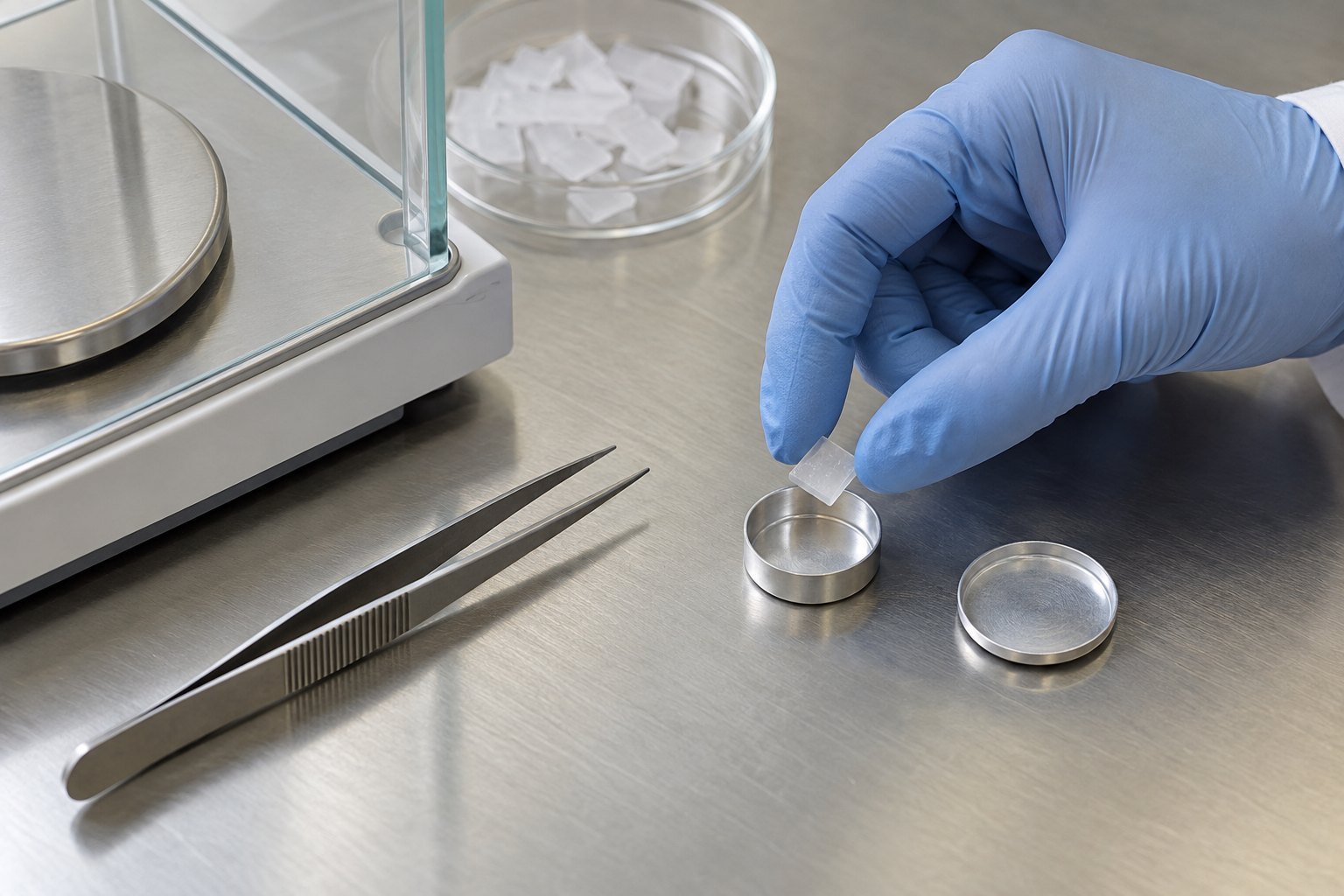
- Identify the material as a representative powder, pellet, granule, or cut specimen. Failure mode: surface selection, cutting damage, or polymer reorientation can change the thermal response.
- Set the maximum melt temperature at least 30 °C above the extrapolated melting end temperature. Set the minimum temperature 50 °C below the extrapolated crystallization end temperature. Failure mode: incomplete erasure or incomplete crystallization reduces peak comparability.
- For conventional DSC, heat and cool at 10 K/min or 20 K/min. Hold at the initial minimum temperature for 5 minutes, hold at each SSA temperature for 20 minutes, and hold at the minimum temperature during each ramp for 5 minutes. Failure mode: unrecorded holds make the result difficult to reproduce.
- Keep the 2 K to 6 K decrement constant through the SSA sequence, then collect the final heating curve at 5 K/min. Failure mode: changing the decrement changes fractionation resolution and can merge neighboring peaks.
- Record the instrument class, pan or crucible, sample mass, purge conditions, calibration status, replicate curves, and any departure from ISO 18177:2025. Failure mode: a technically valid thermogram can still be unsuitable for a compliance claim if its method history is missing.
See also: DSC Test Food Packaging: What Thermal Data Tells You
What should an ISO 18177 DSC report contain?
Your report should allow another laboratory to understand how each melting peak was created and calculated. A peak-temperature list without the SSA history, sample mass, pan type, and enthalpy values is not enough for a purchasing or quality decision.
Which data should you require?
- Sample identification, lot information, physical form, sampling method, and specimen preparation.
- Sample mass in mg, pan or crucible type, lid condition, purge gas, flow condition, and instrument class.
- Calibration basis, test date, heating and cooling rates, maximum and minimum temperatures, initial holds, SSA holds, temperature decrement, and final heating rate.
- Raw or annotated thermograms showing the multiple melting peaks, peak temperatures in °C, peak areas, and enthalpies in J/g.
- Calculated branching content, degree of branching, degree of crystallinity, and branching distribution, with the calculation basis stated.
- Replicate results, observed temperature and enthalpy spread, deviations, and a clear statement of whether the result is conventional, high-performance, fast, modified, or outside the standard scope.
The paper Developing Calibration Reference Materials and Standardized Protocols for Reliable DSC of Polyolefins shows why these details matter. It reports an indium melting-temperature standard deviation of 0.03 °C, but a polyethylene Tm standard deviation of 0.48 °C under its ASTM baseline. An optimized protocol reduced the polyethylene value to 0.11 °C. Sample preparation and mass control can therefore matter more than the nominal instrument resolution.
What can one anonymized TestDSC run look like?
An anonymized conventional-DSC reporting example should expose the full program and replicate peak data. The representative example below uses an ethylene/1-octene copolymer, 2.84 mg, in an aluminum hermetic pan under nitrogen. The values illustrate report granularity, not a universal product limit.
The exact SSA program was: nitrogen pre-purge for 5 minutes; heat from 25 °C to 180 °C at 10 °C/min and hold for 3 minutes; cool to -30 °C at 10 °C/min and hold for 5 minutes; heat to 130 °C and hold for 20 minutes; then use 5 K decrements from 125 °C to 65 °C, holding 20 minutes at each temperature and holding 5 minutes at -30 °C between ramps; finish with heating to 180 °C at 5 °C/min.
| Peak | Replicate A temperature | Replicate A enthalpy | Replicate B temperature | Replicate B enthalpy |
|---|---|---|---|---|
| 1 | 98.6 °C | 12.4 J/g | 98.8 °C | 12.6 J/g |
| 2 | 106.8 °C | 24.1 J/g | 106.6 °C | 23.8 J/g |
| 3 | 114.7 °C | 18.9 J/g | 114.9 °C | 19.2 J/g |
| 4 | 122.5 °C | 9.7 J/g | 122.4 °C | 9.5 J/g |
| 5 | 129.8 °C | 3.6 J/g | 129.6 °C | 3.8 J/g |
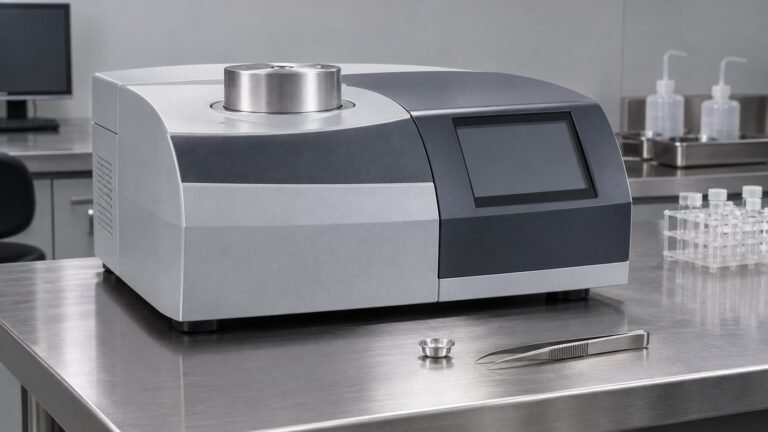
The instrument limit for this conventional run is 10 K/min or 20 K/min for heating and cooling. It does not provide 100 K/min or 200 K/min high-performance operation, and it does not provide 100 K/s fast-DSC chip operation. The report should therefore state conventional ISO 18177:2025 coverage only.
See also: DSC Testing Oxidation Induction: ISO vs ASTM
When can a laboratory not claim full ISO 18177 compliance?
A laboratory should not make an unqualified full-compliance claim when the sample, instrument route, temperature program, or reporting record falls outside the standard. ISO 18177:2025 allows alternative rates or holds by agreement, but the report should identify that agreement or deviation.
| Condition | Required wording or action |
|---|---|
| Material is not an applicable semicrystalline ethylene/1-butene, ethylene/1-hexene, or ethylene/1-octene copolymer | Report an estimation method outside the stated quantitative scope rather than claiming full scope coverage |
| Fast-DSC chip is unavailable | Use the conventional or high-performance route only; do not describe a conventional run as fast DSC |
| Sample mass, pan geometry, or thermal contact is unsuitable | Repeat preparation or document the limitation before interpreting peak areas |
| Rates, holds, or temperature limits differ from the recommended program | State the agreed modification and its likely effect on comparability |
| Replicates show a spread larger than the decision threshold | Report the spread and investigate sample preparation, mass control, calibration, or peak overlap before ranking materials |
ISO 18177:2025 also warns that fast-DSC SSA melting peaks can shift approximately 5 °C to 10 °C lower because the higher cooling rate changes crystallization. Do not compare fast and conventional peak temperatures as though they were interchangeable without a harmonization plan.
Frequently asked questions about an SSA DSC test
Is an SSA DSC test the same as a routine melting DSC test?
No. A routine melting scan gives thermal transition data. An SSA DSC test adds repeated self-nucleation, annealing, controlled temperature decrements, and peak-area calculations to estimate branching-related distributions.
Can ISO 18177 measure every branch in polyethylene?
No. The method estimates the crystallizable fraction. Highly branched material that does not crystallize within the selected temperature program can be underrepresented or excluded.
Can you compare fast-DSC and conventional-DSC peak temperatures directly?
Not without method control. ISO 18177:2025 warns that fast-DSC SSA peaks can be approximately 5 °C to 10 °C lower, so technique and program must stay consistent for comparisons.
How should you order an ISO 18177 DSC test?
Send the copolymer identity, sample form, lot information, expected melting range, required DSC route, and decision threshold. Ask for the complete SSA program, replicate peak temperatures, enthalpies in J/g, calculated branching outputs, and a clear compliance statement. If you need help defining the method, contact TestDSC through our ISO 18177 DSC testing request page →. You can also review our laboratory service approach before sending customer-supplied samples.