DSC Baseline Shift: Real Transition or Artifact?
 testDSC.Admin
A DSC baseline shift is not automatically a new melting or crystallization event. Compare the instrument and specimen baselines, check sample mass before and after the run, and test purge and contact conditions. If mass changes, treat enthalpy in J/g as provisional until evaporation or decomposition is confirmed with complementary evidence.
This workflow addresses a narrow reporting problem: a step, drift, or post-peak movement that may be real, instrumental, or caused by mass loss. TestDSC uses DSC thermal analysis and automated temperature-scanning viscometry as services on customer-supplied samples.
What does a DSC baseline shift mean?
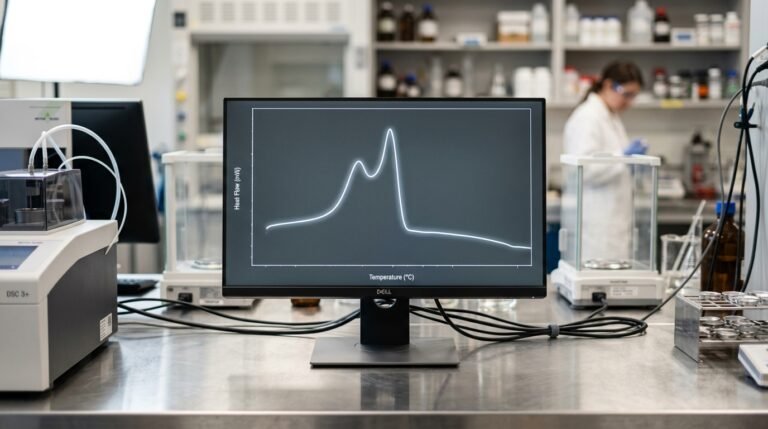
A DSC baseline is the part of the recorded curve where no reaction or transition occurs. ISO 11357-1:2023 §3.7 distinguishes three baselines: the instrument baseline, the specimen baseline, and the virtual baseline. The distinction determines whether you are correcting the measurement or interpreting the specimen.
Which baseline are you looking at?
The instrument baseline is obtained with empty crucibles of identical material and mass in both cell positions. The specimen baseline is the curve outside a transition zone with your specimen and reference crucibles loaded. The virtual baseline is an estimated zero-transition line drawn through the peak region to calculate peak area.
ISO 11357-1:2023 §9.1.4 addresses baseline determination under the selected test conditions. Section 9.2.5 requires the specimen mass to be determined. Section 9.5.1 requires a post-run check for mass loss. These steps prevent a dsc baseline correction from hiding a change in the material itself.
TA Instruments attributes baseline shifts to sample-mass change, heating rate, or specific-heat change. A specimen can change specific heat after curing, crystallization, or melting. If mass changes, TA Instruments warns that enthalpy reported in J/g after the loss is wrong.
How do you diagnose a DSC baseline shift?
Start with the trace shape, then test mass and setup variables. The table below separates a genuine heat-capacity step from post-transition behavior, purge or contact problems, and volatile loss.
| Trace pattern | Likely explanation | Checks | Use when |
|---|---|---|---|
| Baseline step with no returning peak | Heat-capacity change, often a glass transition or thermal-history effect | Compare first and second heating after controlled cooling; confirm stable mass; report the evaluation criterion | Use a specimen-baseline interpretation when the step is repeatable and no mass loss occurs |
| Baseline moves after crystallization or melting | Specific heat changed after the transition, or the virtual baseline does not fit the new heat-flow level | Compare transition enthalpies with alternate baseline types and matched thermal history | Rerun when the integrated area changes materially with the baseline choice |
| Sloped drift, startup hook, or inconsistent replicate | Purge moisture, unequal pan mass, poor thermal contact, pan seating, or specimen movement | Run an empty baseline with the same pans, purge gas, and program; inspect seating; repeat at 10 °C/min or 20 °C/min | Treat it as setup-related when the movement changes with gas, pan, contact, or heating rate |
| Sharp endotherm with measurable mass loss | Evaporation, dehydration, decomposition, or trapped-gas release | Weigh before and after; use TGA, STA, or evolved-gas evidence; inspect the pan and residue | Do not label it a melting peak without confirmation, especially above 300 °C |
A sharp endotherm with measurable mass loss, especially above 300 °C, is a failure trigger for a melting assignment. TA Instruments reports that rapid volatilization can create sharp peaks above 300 °C and can make a minor component look like a melt. Report the event as unconfirmed until mass-loss or evolved-gas evidence supports the identity.
Which dsc thermogram artifacts mimic baseline movement?
Common dsc thermogram artifacts include a startup hook, purge-related drift, unequal reference-pan mass, poor contact, and sample movement. Vvon’s current guidance also treats first heating as informative because it preserves moisture, residual stress, and processing history.
- Preserve the original trace and confirm the endothermic direction, temperature axis, and heating rate. Failure mode: a reversed axis or overwritten first heating can turn a real event into a false interpretation.
- Run an empty baseline with the same crucible material, pan designation, purge gas, flow, and program. Failure mode: a dsc baseline drift caused by pan mismatch or purge moisture can be fitted away instead of corrected.
- Record specimen mass before and after in mg. Failure mode: a mass change invalidates normalized enthalpy in J/g after the loss.
- Check pan seating, specimen contact, and reference-pan compensation. TA Instruments reports best results when the reference pan is 0% to 10% heavier than the sample pan; failure mode: a startup hook or contact change obscures a weak transition.
- Repeat only after deciding whether the issue is reversible. Failure mode: a second DSC run cannot restore information lost through evaporation, decomposition, curing, or an irreversible thermal-history change.
Vvon recommends a second heating after controlled cooling when the material has not decomposed, cured, or otherwise changed irreversibly. Suspected evaporation or decomposition needs mass-loss or evolved-gas evidence, not a baseline fit alone. If the shift persists on a matched empty-pan run, review the method used for your DSC test.
What must an anonymized TestDSC trace include?
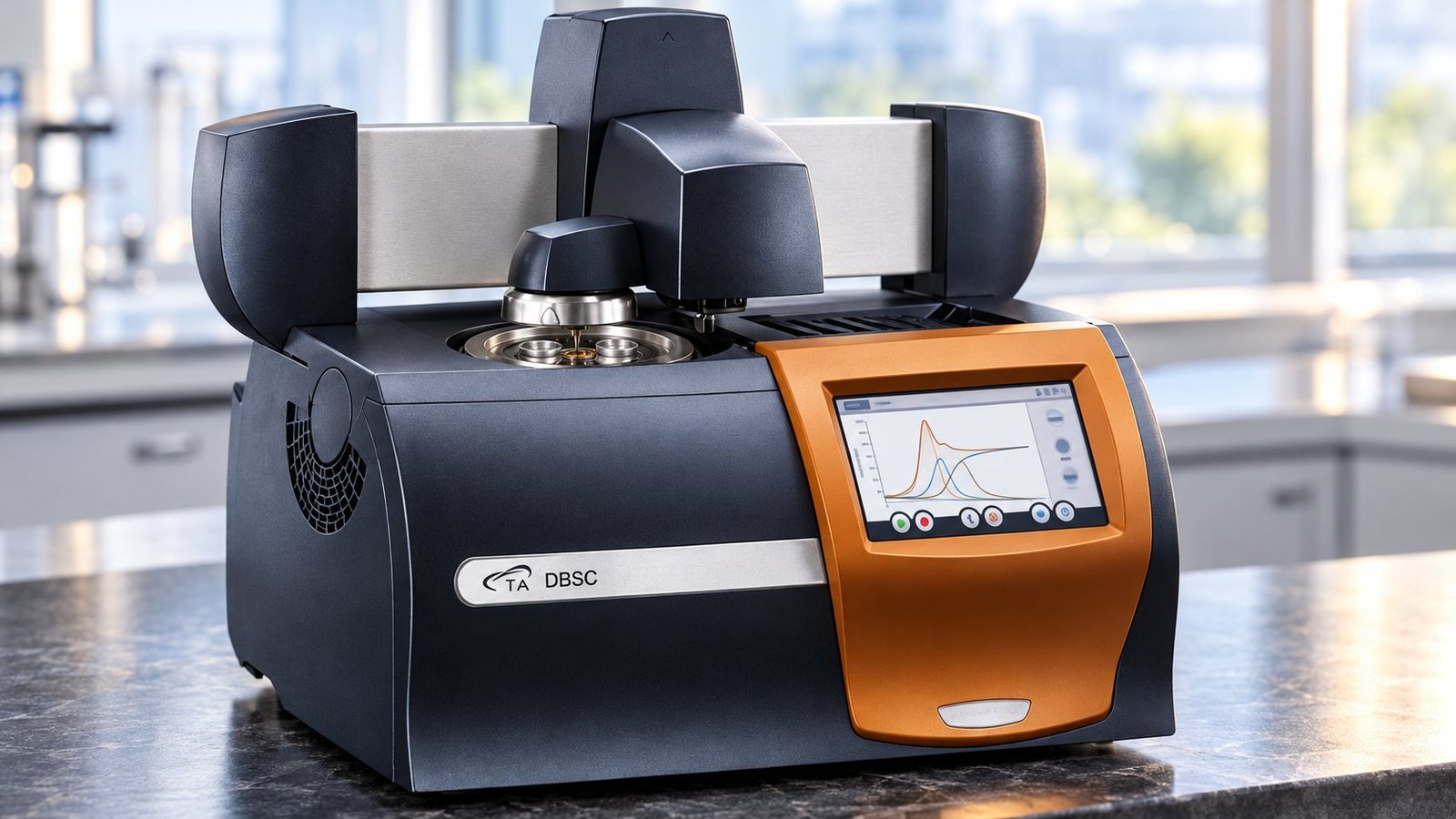
TestDSC requires an anonymized trace with enough method and result data to separate a specimen event from a setup artifact. A screenshot without units, mass checks, or pan information is not service-ready.
- Instrument model and configuration — for example, TA Instruments Discovery X3.
- Pan type and part designation, including whether the pan is standard aluminum, hermetic, or another specified configuration.
- Sample mass before and after the run in mg, reported after pan tare.
- Purge gas and flow in mL/min, such as dry nitrogen at 50 mL/min.
- Heating rate in °C/min, with the full temperature range and any isothermal holds.
- Baseline heat flow in mW at a stated temperature or temperature interval.
- Transition temperatures in °C, with the event identified as a step, onset, peak, or end.
- Enthalpy in J/g, including the mass basis and a note if mass changed.
- Original anonymized trace file or image, not only a cropped peak.
For regulated or flight-critical materials, preserve these fields alongside the application context described in DSC Testing for Aerospace Materials: Ensuring Safety and Performance. If a supplier cannot provide the instrument, pan, mass, purge, rate, baseline, temperature, and enthalpy fields, use Choosing a DSC Testing Lab: What to Look For as a reporting checklist.
When should you rerun DSC or order a complementary test?
Rerun DSC when the trace changes with pan seating, purge, reference mass, or heating rate and the specimen mass remains stable. Order a complementary test when the event includes mass loss, suspected decomposition, or an irreversible chemical change.
- Rerun with matched pans and the same purge when the empty baseline is unstable.
- Rerun after controlled cooling when first-heating history is the suspected cause and the sample remains chemically stable.
- Use TGA or STA when evaporation, dehydration, or decomposition could explain an endotherm.
- Use evolved-gas analysis when the identity of a volatile product matters.
- Use a method such as astm d3895 when the question is oxidative induction rather than an unexplained baseline movement.
FAQ: What does a DSC baseline shift mean for reporting?
Can a baseline shift be a glass transition?
Yes. A step without a returning peak can reflect a heat-capacity change at the glass transition. Confirm stable mass and state the baseline and evaluation method.
Is a post-melting baseline shift automatically an artifact?
No. Crystallization or melting can change specific heat and leave a new specimen baseline. Compare matched thermal histories and test whether the reported enthalpy depends on the virtual baseline.
Can you report J/g after mass loss?
Not as a final material enthalpy without qualification. Record the mass change and confirm the event with TGA, STA, or evolved-gas evidence before assigning a normalized value.
What should you report to TestDSC?
Report the baseline type, trace direction, instrument model, pan designation, sample mass before and after in mg, purge gas and flow in mL/min, heating rate in °C/min, baseline heat flow in mW, transition temperatures in °C, and enthalpy in J/g. For a service-ready review, start with TestDSC DSC thermal analysis and automated temperature-scanning viscometry services →