Low Viscosity Meaning: How to Report It
 testDSC.Admin
Low viscosity meaning: a liquid offers low resistance to flow, but no single numerical cutoff applies across every industry. Purdue Chemistry explains that viscosity changes with temperature and molecular structure; its examples identify water and n-pentane as low-viscosity liquids at 25 °C. A defensible result therefore needs a value, unit, temperature, method, and application context.
The February 2026 STLE feature adds a B2B boundary: lubricant base stocks may be classified as low viscosity below 4 cSt at 40 °C. Performance still depends on solvency, volatility, polarity, and additive response. Ranking pages explain thin behavior and list product-specific ranges, but they do not establish how to report a defensible measurement.
What does low viscosity mean when you report a result?
What does low viscosity mean? It means the sample resists flow less than the comparison required by your application, test method, and temperature. The phrase describes behavior, not a universal pass/fail number.
Purdue Chemistry connects viscosity with molecular attraction, molecular size and shape, and molecular kinetic energy. Those variables change the measured result. If your comparison involves high viscosity vs low viscosity, keep both results in the same viscosity type, unit, and temperature basis.
The practical failure mode is a context-free label. Calling a sample low without stating whether the result is dynamic or kinematic can make a correct measurement look wrong. Calling it low without an application limit can also turn a descriptive result into an unsupported specification.
See also: Viscosity in synthesis and mixing: monitoring blends and reactions
Why does low viscosity at 25°C need a temperature label?
Low viscosity at 25°C means the material met a low-resistance description at that temperature only. It does not establish the same behavior at 40 °C, 80 °C, or another process temperature.
Purdue Chemistry explains that temperature changes molecular kinetic energy, while molecular composition and structure affect attractive forces. For liquids, a temperature change can therefore move the measured viscosity enough to change an application decision.
A temperature-drift failure occurs when the sample is measured at one temperature but reported as another. Record the actual stabilized temperature, not only the chamber setpoint. The phrase low viscosity at 25°C is useful only when 25 °C is controlled and documented.
How do you report low viscosity in cP and cSt?
Low viscosity in cP refers to dynamic viscosity. One cP equals 1 mPa·s for dynamic viscosity. cSt is kinematic viscosity and is not interchangeable with cP because the two measurements describe different quantities.
For a kinematic result, name ASTM D445 or ISO 3104 and include the exact edition and clause specified by the applicable SOP. Do not replace that citation with a generic standard name. If you need to select a procedure, the viscosity test method article is the relevant next step.
| Actual viscosity or limit | Unit | Temperature | Method | Application context |
|---|---|---|---|---|
| 1 | cP = 1 mPa·s | Not applicable to conversion | Dynamic-viscosity unit relationship | Unit notation, not a sample result |
| <4 | cSt | 40 °C | Kinematic method; ASTM D445 or ISO 3104 with exact SOP edition and clause | Lubricant base-stock example from the February 2026 STLE feature |
| Verified report value | cP or cSt | Verified test temperature | Named method and test conditions | Anonymized TestDSC customer sample |
What must a TestDSC customer result show?
A defensible TestDSC customer result must show the measured value, unit, temperature, method, repeatability, and application context. TestDSC runs DSC thermal analysis and automated temperature-scanning viscometry on customer-supplied samples, so the report must identify which measurement produced the number.
- Measured viscosity with the reported unit, such as cP, mPa·s, or cSt.
- Actual sample temperature, including the stabilized value and any programmed temperature range.
- Method details, including dynamic or kinematic measurement and the applicable SOP citation.
- Repeatability, reported as duplicate spread, standard deviation, or RSD when available.
- Application context, such as lubricant base-stock screening, formulation control, or process acceptance.
No verified TestDSC customer report was supplied with this brief. Therefore, no measured customer value, temperature, repeatability, or method can be stated without inventing data. The publishable anonymized result must be taken directly from the report: sample ID, measured value, unit, temperature, repeatability, and complete test conditions.
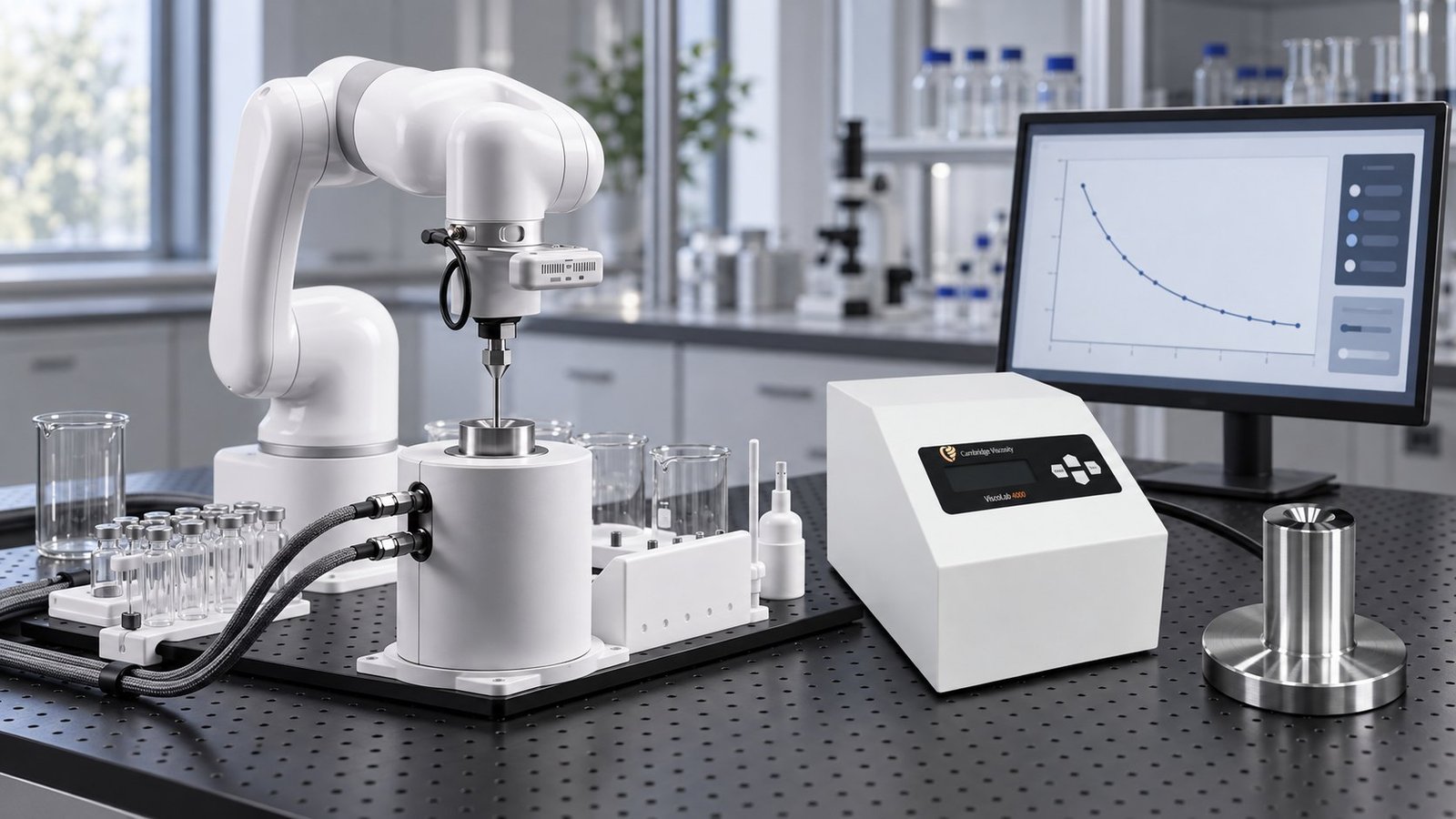
See also: Automated viscosity measurement: more data, less variance
Frequently asked questions about low viscosity meaning
Is low viscosity the same as low cP?
Not always. cP reports dynamic viscosity. A low cP value still needs a test temperature, method, and application limit before it can support a decision.
Does below 4 cSt always mean low viscosity?
No. The February 2026 STLE feature presents below 4 cSt at 40 °C as a lubricant base-stock example. It is not a universal limit for every liquid or industry.
Why can the same sample change classification?
Temperature, molecular structure, viscosity type, and application criteria can change the interpretation. Report the value with its complete measurement conditions.
How should you use the low viscosity meaning?
Use low viscosity as a condition-dependent description, then verify the value, unit, temperature, method, repeatability, and application limit. For a result tied to your customer-supplied sample, review TestDSC viscosity testing services →