DSC Test Phase Change Materials: Buyer Guide
 testDSC.Admin
A DSC test phase change materials study should answer a purchasing question: how much energy does your sample store, over which temperature interval, and how consistently does it release that energy? The useful report is not just a melting peak. You need defined heating and cooling rates, sample mass, cycle selection, heat-flow data, Cp, latent heat, hysteresis, and supercooling.
The scale limitation matters. Oak Ridge National Laboratory’s May 2026 study found that DSC measured phase-change temperature, specific heat, and latent heat at the microscale, while HFMA and system testing exposed scale effects. Supercooling appeared at system scale but was not detected in the smaller test. That makes your test request part of scale-up control, not a paperwork detail.
What a DSC test phase change materials result tells you
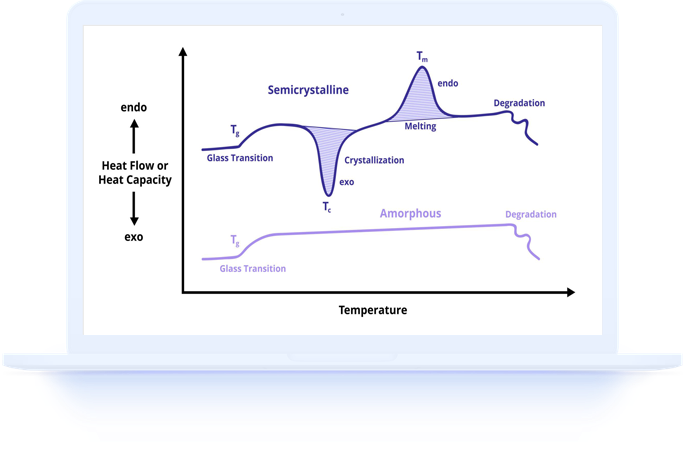
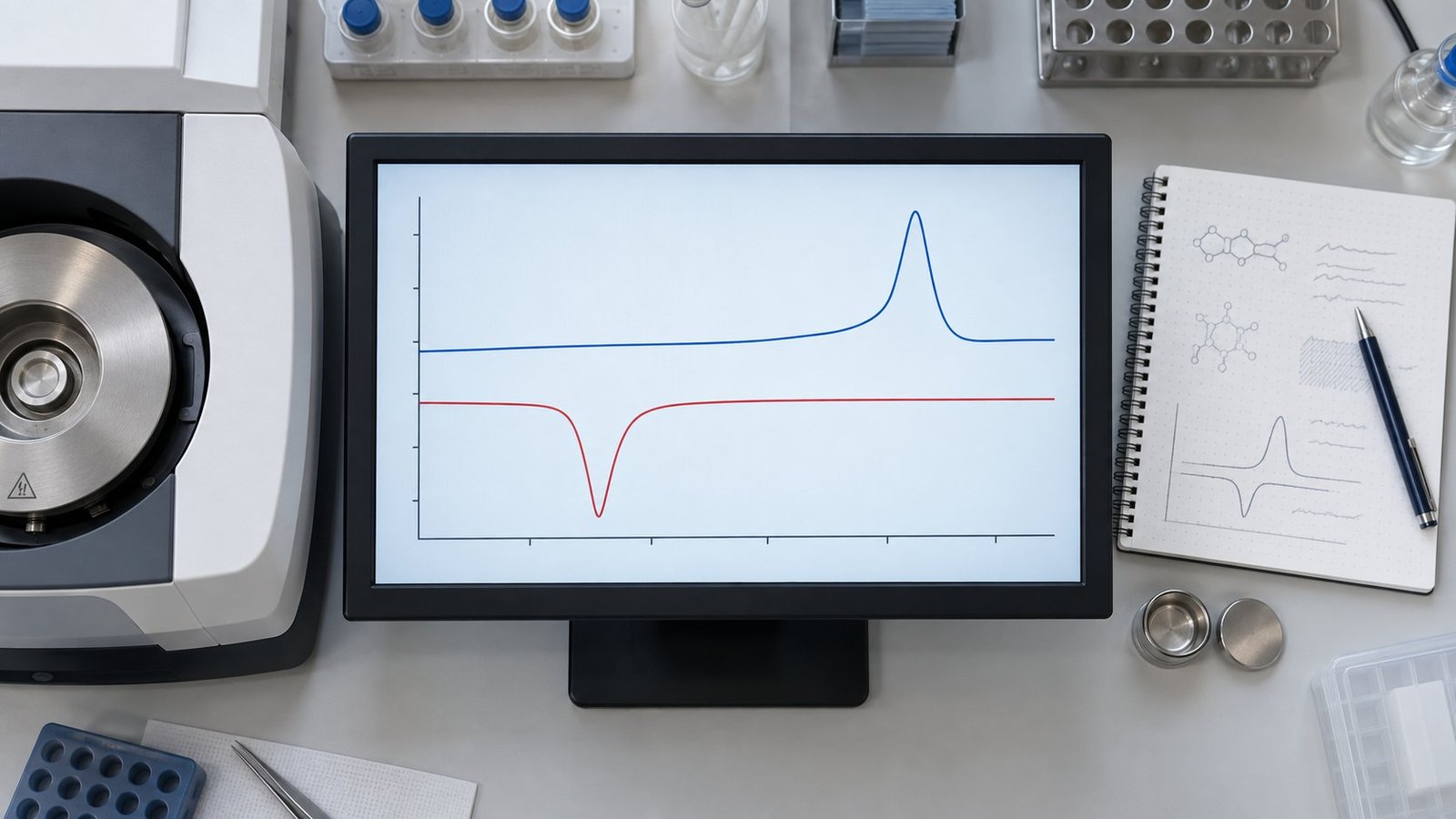
DSC records heat flow as your sample follows a programmed temperature path. An endothermic event commonly marks melting. An exothermic event commonly marks crystallization or solidification. The instrument can report event temperatures and integrate the area under a peak for latent heat measurement, normally in J/g.
For a buyer, the transition temperature is only one decision point. A broad melting interval may affect charge control. A broad crystallization interval may affect discharge timing. Cp in J/g·K helps thermal models estimate sensible heating outside the phase transition. Hysteresis is the separation between melting and crystallization behavior. Supercooling is the gap between the expected transition and the temperature at which crystallization actually begins.
TestDSC reports heat flow versus temperature, including high-resolution signals that help distinguish overlapping events. Its service page lists Cp calculations, thermal event interpretation, and automated event detection. The available temperature range is −160 °C to 400 °C. Typical reports are delivered within 24–72 hours.
A DSC curve does not reproduce a wallboard, finned heat exchanger, or storage vessel. It measures a small prepared sample under controlled conditions. Use the result to compare formulations and define thermal properties. Then confirm system behavior with a suitable larger-scale method.
See also: DSC Test Solar Encapsulant for PV Films
How to order a reliable PCM DSC testing method
Set the temperature program before shipment
Specify the starting temperature, upper temperature, heating rate, cooling rate, holds, atmosphere, and number of cycles. A practical comparison may use 5 °C/min for both heating and cooling. If rate sensitivity matters, add a second condition at 10 °C/min. Keep the same program for every formulation in the comparison.
State whether the report should follow an ISO 11357-style DSC sequence. For specific heat, request an ASTM E1269-based calculation when that standard fits your method. Ask the laboratory to identify whether reported temperatures are onset, peak, extrapolated onset, or another defined point.
Define the sample and the requested outputs
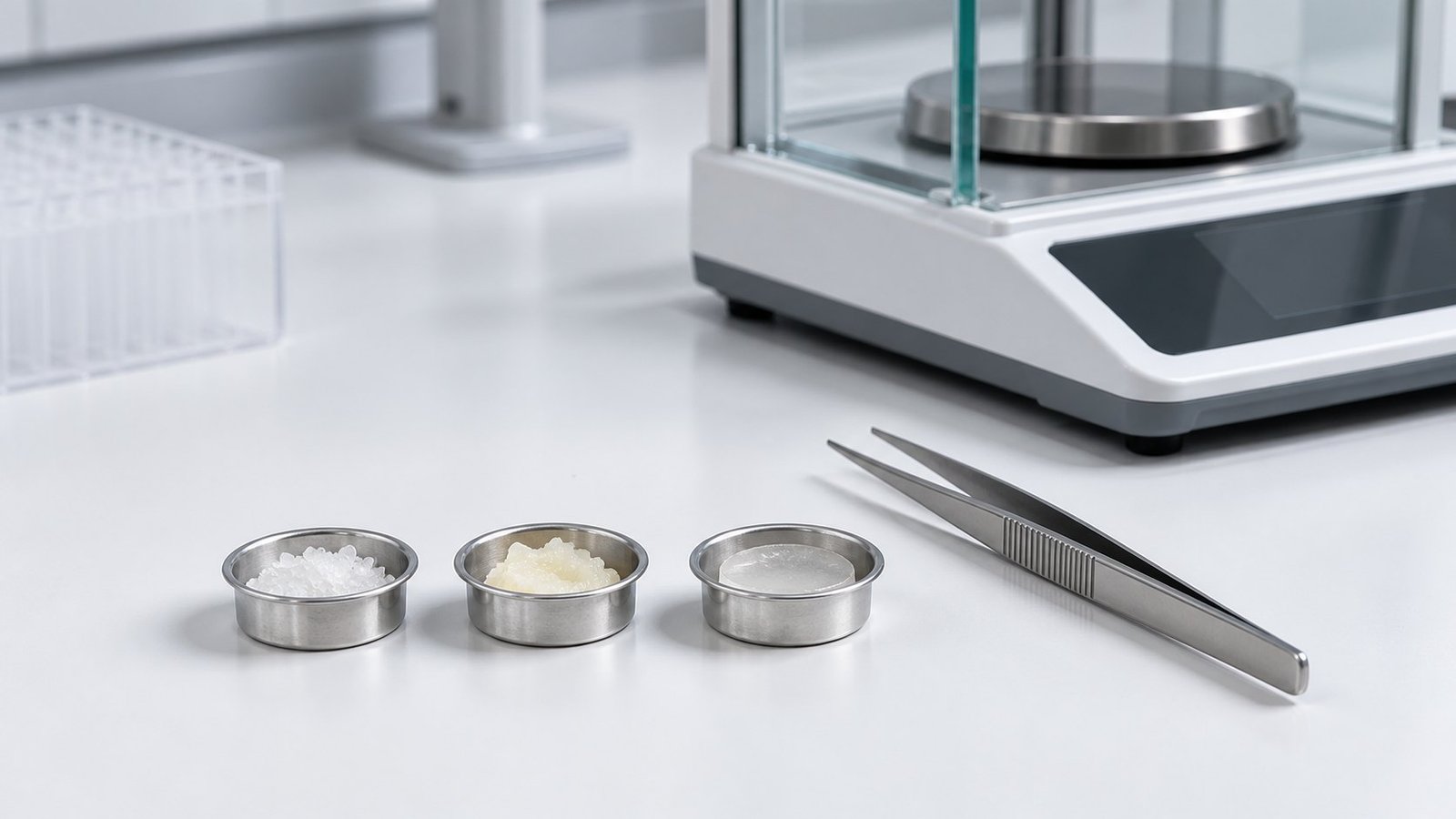
Send the material description, expected transition range, physical form, composition code, storage history, and exact sample mass in mg. Identify whether the sample is a neat PCM, encapsulated PCM, porous composite, or leakage-free composite. State whether the pan should remain sealed or vented under the planned temperature range.
- Heating and cooling rates in °C/min.
- Sample mass in mg and pan configuration.
- First-cycle results versus later-cycle results.
- Melting and crystallization temperatures in °C.
- Latent heat in J/g and Cp in J/g·K.
- Hysteresis and supercooling, with the calculation basis defined.
- Heat-flow curves in mW versus temperature in °C.
If you need a broader formulation screen, ask for automated event detection but review the detected boundaries against the heat-flow curve. Software can identify a peak. Your specification still determines whether that peak answers the engineering question.
See also: DSC Test Kinetics: A Practical Buyer Guide
Use DSC results to manage scale-up risk
The Oak Ridge National Laboratory paper provides a useful warning for thermal energy storage DSC work. Its DSC measurements characterized the PCM at the microscale. HFMA measurements and a finned-tube system then showed behavior that a small pan did not capture. The study evaluated 200 cycles and found system-scale supercooling within 0.2 °C, while smaller characterization methods did not detect it.
That finding changes how you read a negative DSC supercooling test. No detected supercooling in a small sample does not prove that a larger storage module will crystallize at the same temperature. Nucleation, heat-transfer distance, flow paths, containment, and control conditions can change the observed response. Report the DSC result accurately, then label its scale.
The report should also show whether your latent heat value is stable across repeated scans. Compare the first heating cycle with the second and later cycles. A first cycle may include sample history, moisture loss, structural relaxation, or incomplete prior crystallization. Later cycles often provide the cleaner comparison for formulation screening, but both views can be useful.
Read cycle stability as a reporting question
Cycle stability is not one universal number. Specify how many cycles you need, which cycles receive full analysis, and which property defines failure. For a building or process-storage application, that may be latent heat loss, transition-temperature drift, increasing hysteresis, or a new exothermic event.
The 2026 Scientific Reports study, “Evaluation of waste corn cob and copper slag for production of novel leakage-free composite phase change material with improved thermal energy storage,” gives a second useful example. Its composite PCM DSC curves remained nearly overlapping after 650 cycles. Reported enthalpy losses were about 1.2–2.5%. TGA supplied separate information about degradation, so DSC cycling should not be treated as a complete degradation study.
For your purchase order, distinguish thermal cycling from chemical stability. Request DSC for melting, crystallization, Cp, latent heat, and cycle-to-cycle drift. Request TGA or another method separately if mass loss or decomposition is a concern. If your material is liquid or low-viscosity during testing, TestDSC also offers automated temperature-scanning viscosity testing as a separate service.
DSC test phase change materials FAQ
Can DSC measure supercooling?
Yes, if the cooling program produces a measurable crystallization event. Define the reference temperature and report the cooling rate in °C/min. A small DSC sample may not reproduce supercooling observed in a larger system.
Should the first cycle be included?
Usually, yes. Ask for first-cycle and later-cycle results when sample history may affect the transition. This separates conditioning effects from repeatable thermal behavior.
What does a standard DSC report include?
TestDSC reports heat flow versus temperature, event identification, Cp calculations, and thermal interpretation. Confirm whether you also need raw data, cycle overlays, onset values, peak values, or an ISO 11357-aligned method. The DSC testing FAQ can help define the request.
Order a DSC test phase change materials study
A useful DSC test phase change materials request names the rates, mass, cycle history, transition definitions, and reporting units before the sample arrives. TestDSC can analyze customer-supplied samples from −160 °C to 400 °C, report heat flow, calculate Cp, detect thermal events automatically, and typically return results within 24–72 hours. Request a DSC test phase change materials scope for your sample →