DSC Test Kinetics: A Practical Buyer Guide
 testDSC.Admin
A routine DSC scan gives you an onset temperature, peak temperature, and enthalpy. It does not automatically give you reaction kinetics. DSC test kinetics requires a planned series of measurements, controlled heating conditions, and calculations that connect heat flow with reaction conversion.
For R&D teams, the practical question is whether a laboratory will deliver a defensible kinetic dataset or only a thermal screen. ISO 19717:2026, published in May 2026, defines a model-free isoconversional approach for determining activation energy as a function of conversion from dynamic or isothermal DSC measurements. This guide focuses on what to request before you approve a quotation.
What DSC Test Kinetics Can Tell You
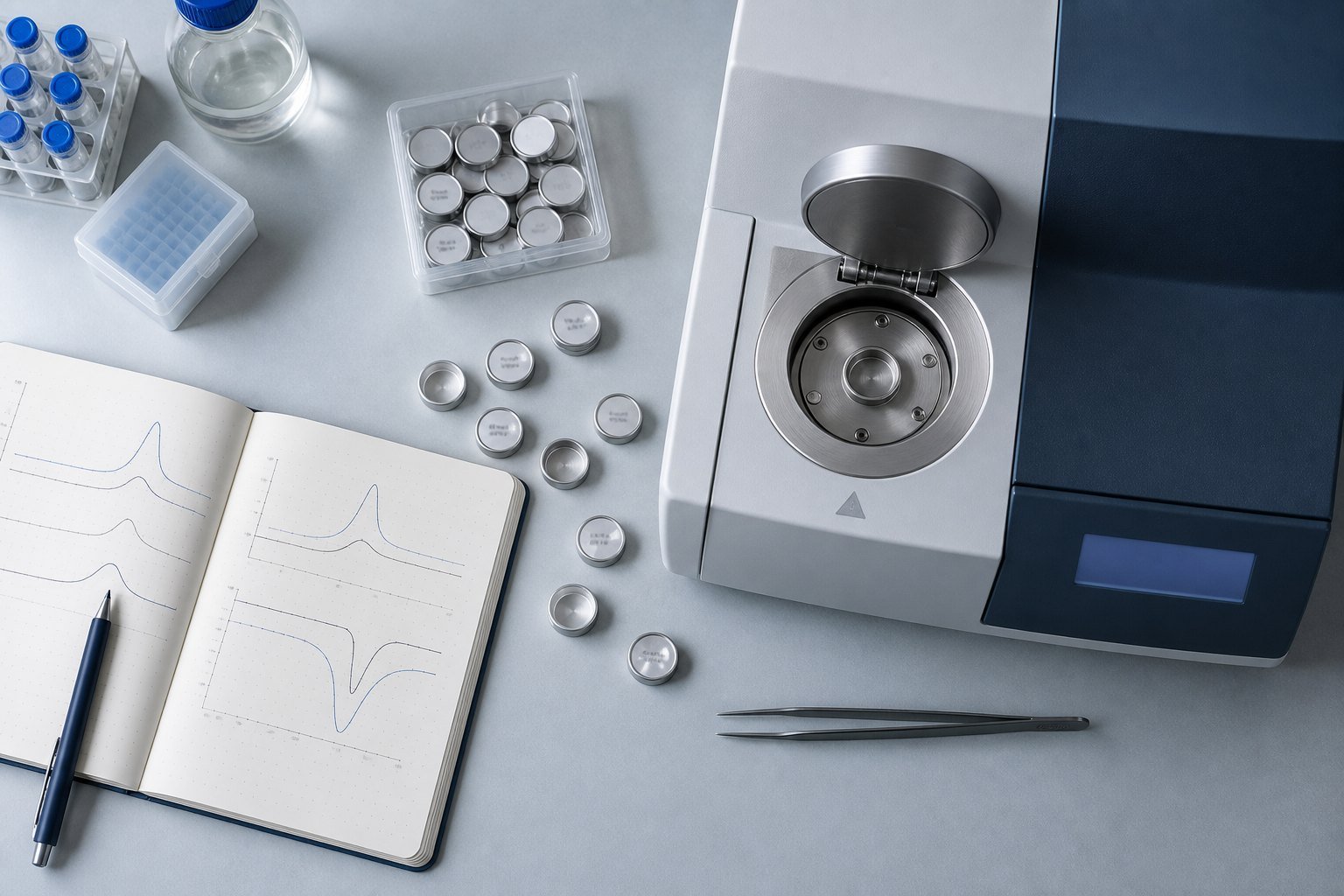
Kinetic information describes how reaction rate changes with temperature and conversion. Conversion is the fraction of the measured reaction completed. A DSC trace can estimate conversion from integrated reaction heat when the selected event is isolated and the baseline is suitable.
The result differs from a single peak temperature. You may receive activation energy values at conversion levels such as 0.10, 0.30, 0.50, 0.70, and 0.90. A stable profile can support comparisons between formulations, cure schedules, or material lots. A changing profile can show that one reaction model does not describe the full event.
From heat flow to conversion
The instrument records heat flow, commonly reported in mW, against temperature or time. The laboratory integrates the reaction area and normalizes it to sample mass, often reported in J/g. That processed signal becomes the basis for conversion-dependent calculations. Sample mass, pan type, baseline selection, atmosphere, and temperature program all affect the result.
A resin may show a broad exotherm from 80 °C to 180 °C. A filled formulation may shift the baseline or split the event. Moisture, residual solvent, catalyst concentration, and sample mass can change apparent heat flow. A kinetic calculation cannot correct an uncontrolled experiment after the fact.
Routine screen versus validated kinetic study
A routine DSC screen usually answers whether an event occurs and where it appears. A kinetic study asks whether the event behaves consistently across multiple programs. That difference affects the quotation, sample quantity, run time, data review, and reporting.
- Routine screen: one or two heating programs, a thermal transition summary, and peak or onset values.
- Kinetic study: multiple heating rates or isothermal holds, conversion calculations, model checks, and a stated limitation review.
- Buyer requirement: raw heat-flow files, processed curves, calculation method, replicate results, and clear identification of assumptions.
See also: DSC test
ISO 19717 DSC and Conversion-Dependent Results
ISO 19717:2026 — Plastics — Differential scanning calorimetry (DSC) or thermogravimetric analysis (TGA) — Model-free kinetics based on the non-linear incremental isoconversional method — describes a model-free route. The method determines activation energy as a function of conversion rather than forcing the entire reaction into one assumed kinetic model.
The ISO 19717 DSC approach can use dynamic or isothermal measurements. Dynamic measurements vary temperature according to a programmed heating rate. Isothermal measurements hold the sample at a selected temperature and track heat flow over time. Your laboratory must choose conditions that separate the target reaction from evaporation, melting, crystallization, or other thermal events.
What the ISO method does not guarantee
A report mentioning ISO 19717:2026 does not, by itself, prove that every part of the work is ISO-compliant. Confirm the edition, calculation procedure, instrument controls, number of runs, and reporting basis. Ask whether the laboratory is applying the standard in full or using a related calculation for development work.
ISO 19717:2026 also states a limitation for polymers in the glassy state. That limitation matters when segmental mobility controls the observed reaction rate. A conversion-dependent result may still be useful for comparison, but you need the laboratory to explain whether the sample condition falls within the method’s intended use.
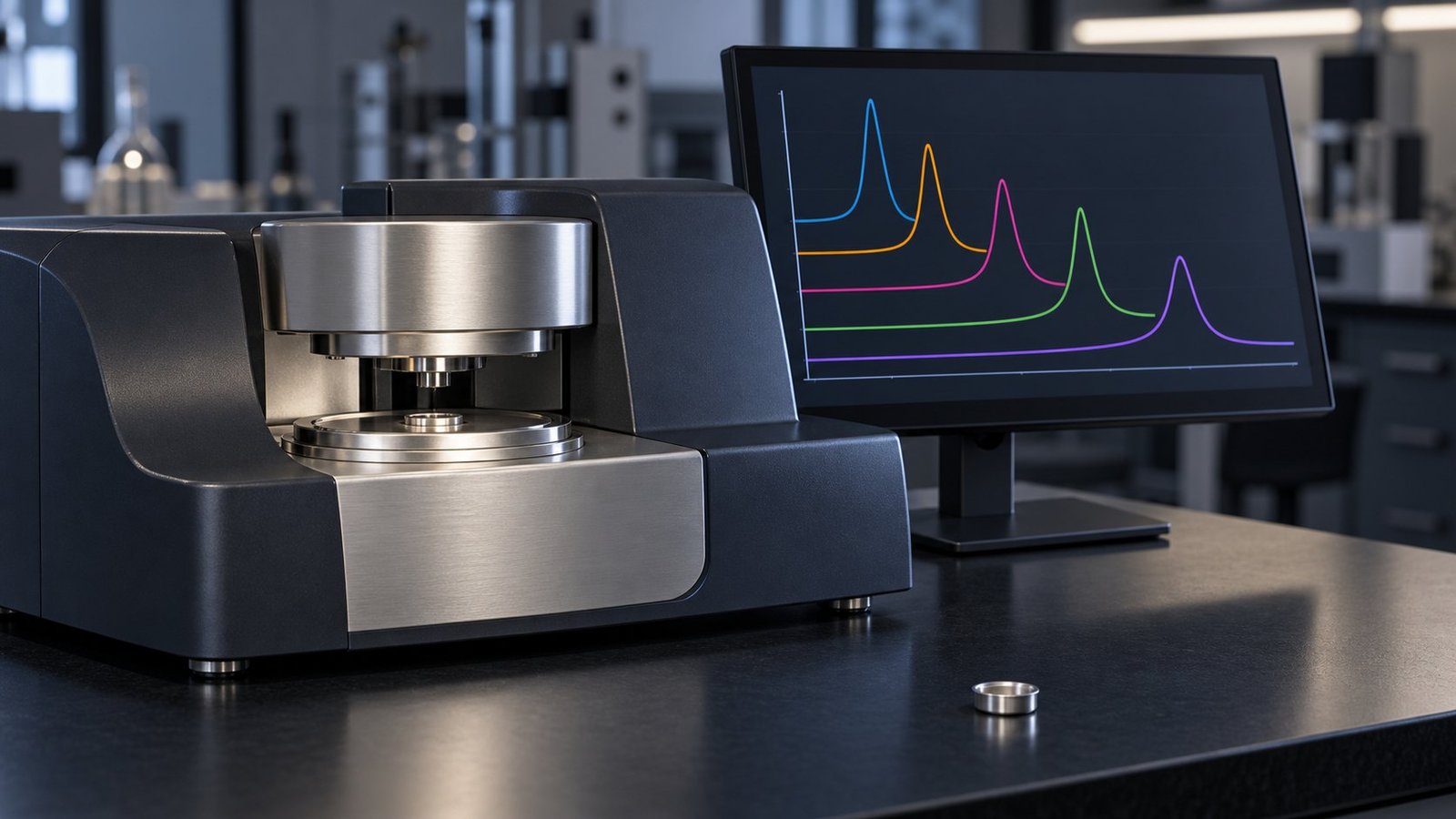
How to Scope a Multi-Rate DSC Study
Before you request a DSC testing quotation for kinetic work, describe the reaction, expected temperature range, sample history, and decision you need to make. Do not send only a product name. The laboratory needs enough information to distinguish curing, decomposition, oxidation, crystallization, and evaporation.
Questions for TestDSC
Ask TestDSC to add first-hand detail about how it would scope your multi-rate DSC study. The following points should appear in the proposal or be confirmed before testing:
- Sample mass: confirm the target mass in mg, pan type, sealing approach, and how many portions you must provide.
- Atmosphere: specify nitrogen, air, oxygen, or another purge gas, including the flow rate in mL/min when relevant.
- Temperature range: identify the proposed start and end temperatures, such as 30 °C to 250 °C, and explain why the range captures the full event.
- Heating rates: ask whether the study will use rates such as 5 °C/min, 10 °C/min, and 20 °C/min, or a different set justified by the reaction.
- Replicate runs: confirm which rates or isothermal temperatures will be repeated and how variation will be reported.
- Raw files: request the original heat-flow files, temperature and time channels, processed curves, and baseline information.
- Calculations: confirm whether conversion and activation-energy calculations are included or require customer software, and name the calculation method.
A useful proposal also states whether the laboratory will review overlapping peaks, partial conversion, unstable baselines, and run-to-run drift. If the sample has limited availability, tell the laboratory the maximum number of pans and milligrams available before the program is designed. That constraint can change the balance between replicates and heating rates.
Where ASTM E698-23 Fits
ASTM E698-23 covers overall kinetic parameters for exothermic reactions using DSC and the Flynn/Wall/Ozawa method. It is an established multi-heating-rate approach. Its output is intended to describe overall kinetics under conditions that can be represented by the Arrhenius equation and a general rate law.
This makes ASTM E698-23 different from model-free DSC kinetics under ISO 19717:2026. ASTM E698-23 commonly summarizes the reaction with overall kinetic parameters. ISO 19717:2026 is intended to show how activation energy varies with conversion. Neither result should be selected by name alone. The reaction behavior and the decision you need to support should determine the approach.
Read the ASTM limitations before testing
ASTM E698-23 cautions that its technique may not apply to partially inhibited reactions. It may also fail when simultaneous or consecutive reaction steps contribute to the signal. The method may not apply when a material undergoes a phase transition and the reaction rate is significant at the transition temperature.
ASTM E698-23 notes that kinetic parameters, the general rate law, and reaction enthalpy can support thermal-hazard evaluation using ASTM Practice E1231. That possible use does not make a DSC kinetics report a substitute for dedicated process-safety testing. Use the appropriate safety study, equipment, controls, and review for your process.
See also: DSC Test Phase Change Materials: Buyer Guide
DSC Test Kinetics Questions Buyers Ask
Can one DSC run determine activation energy?
Usually, no. A defensible activation-energy result normally requires multiple dynamic heating rates or isothermal measurements. One scan can identify an event, but it cannot establish how the rate changes across temperature or conversion.
Does a routine DSC report include kinetic calculations?
Not necessarily. Ask whether the quoted service includes conversion curves, activation-energy calculations, raw files, and interpretation. Some laboratories provide the measurements while your team performs calculations in customer software.
Should you choose ISO 19717:2026 or ASTM E698-23?
Choose based on the reaction and the decision. ISO 19717:2026 is suited to conversion-dependent analysis, subject to its stated limitations. ASTM E698-23 addresses overall exothermic-reaction kinetics and may support thermal-hazard evaluation when used with the relevant safety practice.
What should you send with the sample?
Send the formulation or material history, expected reaction temperature, storage condition, hazard information, available sample mass in mg, and the question the data must answer. Include whether oxygen exposure, moisture, or prior curing could affect the reaction.
Specify the Right DSC Study Before You Buy
The key buying decision is not whether a DSC instrument can produce a peak. It is whether the test plan can support the kinetic claim you need. Separate a routine thermal screen from a multi-rate or isothermal study. Define sample mass, atmosphere, temperature range, heating rates, replicates, raw files, and calculation ownership before the runs begin.
Use TestDSC’s testing questions and service information to prepare your request, then ask for confirmation of the selected standard, limitations, and deliverables. For a project-specific scope, contact TestDSC about your DSC test kinetics requirements →
How many DSC runs are needed for kinetics?
Request at least 3 distinct heating-rate runs for a model-free isoconversional calculation, such as 5, 10, and 20 °C/min. ISO 19717:2026 uses the relationship between temperature, conversion, and reaction rate across multiple programs; one routine scan cannot supply that comparison.
The laboratory should show whether all 3 curves support the reported conversion range, for example α = 0.10 to 0.90. If one run has an incomplete event, baseline interference, or poor signal above α = 0.80, the report should identify the affected range rather than silently calculate it.
Can DSC kinetics predict cure time at a processing temperature?
A DSC kinetics study can estimate the time needed to reach a selected conversion at a processing temperature, such as 90% conversion at 120 °C, when the measured data support that prediction. The output should state the predicted time in minutes and the temperature and conversion range used.
Ask for an isothermal check near the intended process condition when the prediction is important. For example, a 120 °C hold can show whether the reaction continues as predicted or develops a diffusion or glass-transition limitation that is not evident in dynamic scans.