
Thermal Stability Testing with DSC: Methods and Applications
Thermal Stability Testing with DSC: Methods and Applications
 DSC Test
Thermal Stability Testing with DSC: Methods and Applications
What Is Thermal Stability and Why Test It?
Thermal stability refers to a material’s ability to resist chemical changes when exposed to elevated temperatures. Materials with high thermal stability maintain their structure, properties, and performance at high temperatures, while thermally unstable materials may decompose, oxidize, or undergo other degradative reactions.
Understanding thermal stability is critical for selecting materials for high-temperature applications, determining safe processing conditions, predicting shelf life under thermal stress, and evaluating the safety of reactive or energetic materials.
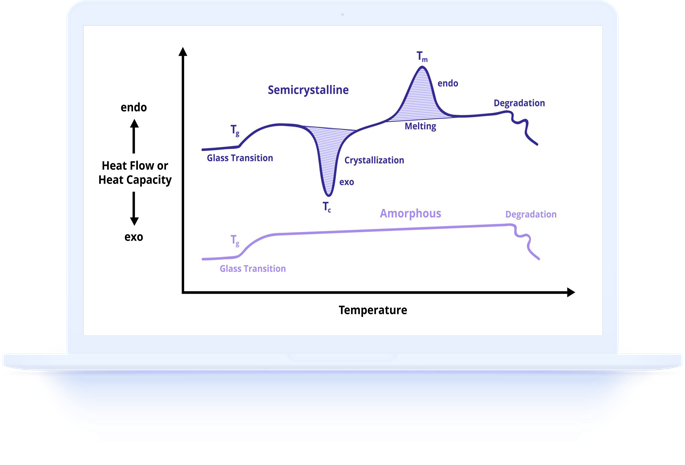
DSC measures thermal stability by detecting the onset of exothermic decomposition or oxidation reactions as a sample is heated. The temperature at which these reactions begin provides a direct measure of the material’s thermal resistance, while the magnitude and nature of the thermal events reveal the type and severity of the degradation process.
DSC Methods for Thermal Stability Assessment
DSC offers several approaches for assessing thermal stability, each suited to different materials and objectives. Dynamic temperature scanning, where the sample is heated at a constant rate through an extended temperature range, provides an overview of all thermal events including decomposition.
For more detailed assessment, isothermal methods hold the sample at a specific temperature and monitor for the onset of exothermic activity over time. This approach directly simulates conditions encountered during long-term storage or continuous high-temperature use.
The oxidative induction time (OIT) test is a specialized isothermal stability method where the sample is held at elevated temperature under oxygen. The time elapsed before the onset of oxidation provides a sensitive measure of antioxidant effectiveness and oxidative stability.
Onset of Decomposition Temperature
The onset of decomposition temperature measured by DSC marks the point at which a material begins to break down chemically. This temperature is typically determined as the extrapolated onset of the first significant exothermic peak observed during a heating scan.
For polymers, the decomposition onset typically ranges from 200 to 500 degrees Celsius depending on the polymer type and the presence of stabilizers. For pharmaceutical materials, decomposition may occur at much lower temperatures, sometimes overlapping with melting, which can complicate data interpretation.
The measured decomposition onset depends on the heating rate and atmospheric conditions used in the DSC measurement. Faster heating rates shift the observed onset to higher temperatures due to kinetic effects, while oxidative atmospheres can lower the onset compared to inert gas environments.
Isothermal Stability Studies
Isothermal stability studies provide the most practically relevant data for predicting material behavior under continuous thermal exposure. By holding the sample at a temperature representative of its service or storage conditions and monitoring for the onset of degradation, DSC directly measures the material’s resistance to thermal damage.
The induction time measured in isothermal experiments can be used to estimate shelf life or service life through Arrhenius kinetic analysis. By measuring induction times at several elevated temperatures and extrapolating to the actual use temperature, analysts can predict how long a material will remain stable under real-world conditions.
This approach is widely used in the polymer industry for evaluating stabilizer packages, in the pharmaceutical industry for establishing drug substance and product shelf lives, and in the food industry for predicting the oxidative stability of oils and fats.
Oxidative Stability vs Thermal Stability
Thermal stability and oxidative stability are related but distinct concepts. Thermal stability refers to resistance to decomposition caused by heat alone, while oxidative stability specifically addresses resistance to degradation caused by reaction with oxygen, which is typically accelerated by heat.
DSC differentiates between these mechanisms by testing under different atmospheric conditions. Measurements under nitrogen or argon assess purely thermal stability by removing oxygen from the equation. Measurements under oxygen or air assess oxidative stability, where the combination of heat and oxygen drives degradation.
For most organic materials including polymers, food products, and pharmaceuticals, oxidative degradation occurs at lower temperatures and proceeds faster than purely thermal decomposition. This is why antioxidant additives are critical for extending the useful life of these materials.
Applications Across Industries
Thermal stability testing by DSC serves critical applications across multiple industries. Polymer compounders evaluate stabilizer effectiveness by comparing the thermal stability of formulations with different antioxidant and heat stabilizer packages.
Electronic component manufacturers verify that encapsulants, soldering materials, and substrate materials can withstand the thermal exposures encountered during assembly and operation. Lead-free soldering processes with peak temperatures of 260 degrees Celsius demand materials with proven thermal stability at these conditions.
Energy storage researchers assess the thermal stability of battery electrolytes, electrode materials, and separator films to evaluate safety risks. Thermal runaway in lithium-ion batteries begins with decomposition of these components, and DSC data helps identify the critical temperatures and energy release associated with each decomposition step.
Thermal Stability Testing Services
Our laboratory provides comprehensive thermal stability testing using DSC under both inert and oxidative atmospheres. We determine decomposition onset temperatures, oxidative induction times, and isothermal stability data for polymers, pharmaceuticals, food ingredients, electronic materials, and other products.
Contact our technical team to discuss your thermal stability testing requirements and receive a quotation tailored to your specific materials and applications.
