
Specific Heat Capacity Measurement Using DSC: Methods and Standards
Specific Heat Capacity Measurement Using DSC: Methods and Standards
 DSC Test
Specific Heat Capacity Measurement Using DSC: Methods and Standards
What Is Specific Heat Capacity?
Specific heat capacity, commonly symbolized as Cp, is the amount of energy required to raise the temperature of one gram of a material by one degree Celsius (or one Kelvin). This fundamental thermodynamic property is essential for thermal engineering calculations, process design, and understanding how materials respond to temperature changes.
Materials with high specific heat capacity, like water at 4.18 joules per gram per degree Celsius, absorb large amounts of energy with modest temperature increases, making them effective thermal buffers. Materials with low specific heat capacity, like metals at around 0.4 to 0.9 joules per gram per degree Celsius, heat up and cool down quickly.
In practical applications, Cp data is needed for calculating heating and cooling requirements in manufacturing processes, designing thermal management systems, predicting temperature distributions in molded parts, and modeling the thermal behavior of structures exposed to fire or extreme temperatures.
DSC Methods for Measuring Heat Capacity
DSC offers two primary methods for measuring specific heat capacity: the classical three-run sapphire method and the modulated DSC (MDSC) method. Both produce reliable results when properly executed, though each has advantages in different situations.
The sapphire method involves three sequential DSC runs under identical conditions: an empty pan baseline, a sapphire reference standard, and the sample being tested. By comparing the heat flow signals from these three runs, the specific heat capacity of the sample is calculated at each temperature point across the measurement range.
The MDSC method superimposes a sinusoidal temperature modulation onto the linear heating program. The reversing heat flow signal is directly related to heat capacity, allowing Cp determination from a single run without the need for separate baseline and reference measurements. This approach is faster and often more convenient for routine measurements.
The Sapphire Reference Method (ASTM E1269)
The ASTM E1269 standard method for specific heat capacity determination uses synthetic sapphire (alpha-alumina) as the reference material because its Cp values are precisely known across a wide temperature range from minus 100 to over 1000 degrees Celsius.
The procedure requires three DSC runs at identical conditions: first, a scan with two empty pans to establish the instrument baseline; second, a scan with a known mass of sapphire in the sample pan; and third, a scan with the unknown sample in the same pan. The Cp of the sample is calculated by comparing the heat flow differences between each run.
Critical factors for accurate results include precise mass determination of both the sapphire and sample, consistent pan positioning, stable purge gas flow, and adequate equilibration time between runs. Temperature equilibration at the starting temperature should continue until the heat flow signal is completely stable before beginning each heating scan.
The method achieves accuracy of approximately 3 to 5 percent for well-behaved materials and can approach 1 to 2 percent accuracy with careful technique and high-quality instruments.
Modulated DSC Method for Cp
Modulated DSC offers a more efficient approach to heat capacity measurement by extracting Cp data from a single experiment. The sinusoidal temperature modulation (typically plus or minus 0.5 to 1 degree Celsius with a period of 40 to 60 seconds) allows the instrument to separate the heat capacity component from other thermal events.
The key advantage of MDSC for Cp measurement is that it eliminates the systematic errors introduced by non-reproducible conditions between the multiple runs required in the sapphire method. Since all information comes from a single scan, any instrumental drift or environmental changes during the measurement affect the entire result uniformly.
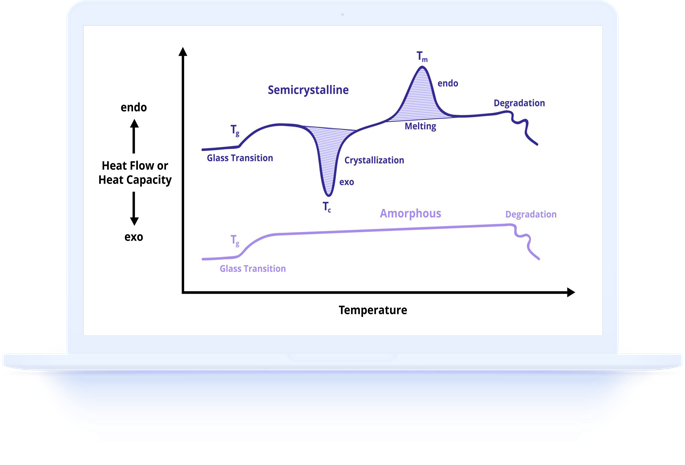
MDSC Cp measurements are particularly valuable when thermal events such as glass transitions or reactions overlap with the temperature region of interest. The modulated approach separates the reversing (heat capacity) component from non-reversing events, providing clean Cp data even in complex temperature regions.
Factors Affecting Heat Capacity Measurements
Several factors can affect the accuracy and reliability of Cp measurements by DSC. Sample mass should be optimized to provide adequate signal without introducing thermal gradients. For most materials, 10 to 20 milligrams provides a good balance, though low-density materials may require more mass.
Pan selection matters for Cp measurements because different pan materials and configurations have different heat capacities themselves. Maintaining consistent pan types and masses between baseline, reference, and sample runs is essential for the sapphire method.
Heating rate affects the signal-to-noise ratio in Cp measurements. Higher heating rates provide larger signals but may introduce thermal lag effects. A rate of 10 to 20 degrees per minute is typically optimal for the sapphire method, while MDSC uses slower underlying rates of 2 to 5 degrees per minute.
Moisture and volatile content in the sample can cause apparent Cp anomalies as evaporation absorbs energy. For hygroscopic materials, hermetically sealed pans should be used to prevent mass loss during the measurement.
Applications of Heat Capacity Data
Specific heat capacity data serves essential engineering and scientific applications across numerous fields. In plastics processing, Cp values are needed to calculate the energy required to heat polymer pellets from room temperature to processing temperature, directly affecting extruder and injection molding machine design.
Thermal management engineers use Cp data to design cooling systems for electronics, batteries, and industrial equipment. The heat capacity of a battery cell’s materials determines how quickly it heats up during charge and discharge cycles and how much cooling capacity is needed to maintain safe operating temperatures.
Building materials are evaluated for their thermal mass using Cp data, which affects heating and cooling energy requirements in buildings. Materials with high heat capacity moderate indoor temperature swings, reducing energy consumption for climate control.
Food process engineers need Cp values to calculate the energy required for pasteurization, sterilization, cooking, and freezing operations, ensuring product safety while minimizing energy consumption.
Professional Heat Capacity Testing
Our testing laboratory offers specific heat capacity measurements using both the ASTM E1269 sapphire method and MDSC techniques. We provide Cp data across temperature ranges from minus 80 to 600 degrees Celsius to meet the needs of diverse applications.
Our Cp measurement services include single-temperature point measurements for engineering calculations, continuous Cp versus temperature curves for thermal modeling, and comparative measurements for evaluating material alternatives. All results include uncertainty estimates and full documentation of measurement conditions.
Contact our laboratory to discuss your specific heat capacity measurement requirements and timeline.
