
Purity Analysis by DSC: The Van’t Hoff Method Explained
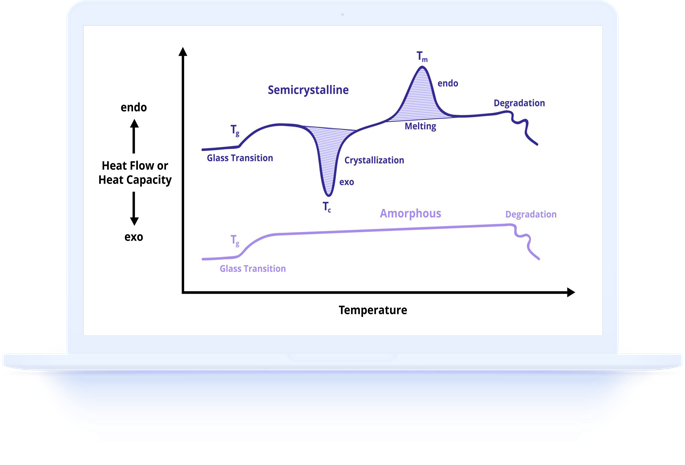
Purity Analysis by DSC: The Van’t Hoff Method Explained
 DSC Test
Purity Analysis by DSC: The Van’t Hoff Method Explained
How Impurities Affect Melting Behavior
Impurities in a crystalline material disrupt the regularity of the crystal lattice, requiring less energy to initiate melting and causing the melting process to occur over a broader temperature range. This fundamental thermodynamic principle, described by the van’t Hoff equation, forms the basis for DSC purity analysis.
In a pure crystalline substance, all molecules are identical and occupy well-defined positions in the crystal lattice. The melting occurs sharply at a single temperature with a narrow peak. When impurity molecules are present, they create local lattice distortions that lower the energy barrier for melting, depressing the melting onset temperature.
The extent of melting point depression is proportional to the mole fraction of impurity present. This quantitative relationship allows DSC to determine the total impurity content from careful analysis of the melting peak shape, without needing to identify or separate the individual impurities.
The Van’t Hoff Method for Purity Determination
The van’t Hoff equation relates the melting point depression to the impurity concentration. In its linearized form used for DSC purity analysis, it predicts that plotting the sample temperature against the reciprocal of the fraction melted at each point along the melting curve should yield a straight line whose slope is proportional to the mole fraction of impurity.
The practical application involves measuring the DSC melting peak at a slow heating rate (typically 1 to 2 degrees per minute for maximum accuracy), dividing the peak into incremental fractions, and analyzing the relationship between temperature and fraction melted. Software algorithms perform this analysis automatically, reporting the total mole percent impurity.
The method assumes that the impurity forms a eutectic system with the host material (no solid solution formation), that the impurity is uniformly distributed, and that thermal equilibrium is maintained during the measurement. These assumptions limit the applicability of the method to certain types of samples.
Step-by-Step DSC Purity Analysis
A DSC purity analysis begins with careful sample preparation. The sample should be finely ground to ensure uniform composition and should be weighed precisely on a microbalance. Sample masses of 1 to 3 milligrams are recommended to minimize thermal gradients and approach equilibrium conditions.
The DSC method uses a slow heating rate, typically 0.5 to 2 degrees per minute through the melting region, to maintain near-equilibrium conditions as required by the van’t Hoff analysis. The slow rate produces a narrow, well-defined peak that provides the resolution needed for accurate fraction-melted analysis.
After data collection, the analysis software performs the linearized van’t Hoff calculation, generating a plot and reporting the calculated mole percent impurity, the corrected melting point of the pure compound, and statistical quality indicators for the fit. Results are typically reported with an uncertainty estimate based on the linearity of the van’t Hoff plot.
Advantages and Limitations of DSC Purity Testing
The DSC purity method offers significant advantages: it requires only milligrams of sample, no reference standards, no chromatographic separation, and takes less than an hour. It provides a total impurity value regardless of the number or identity of individual impurities, making it a valuable screening tool.
However, the method has important limitations. It only works for crystalline materials that melt without decomposition. It assumes a eutectic impurity system and will give incorrect results if the impurity forms a solid solution with the host material. The practical detection range is approximately 0.01 to 5 mole percent impurity.
For pharmaceutical applications, DSC purity analysis is widely used as a screening tool to complement chromatographic methods like HPLC. It provides a different perspective on purity (total impurity including non-UV-active species) and can detect impurities that chromatographic methods might miss.
Pharmaceutical Applications of DSC Purity Analysis
Pharmaceutical regulatory agencies worldwide accept DSC purity data as supporting evidence in drug substance characterization. The International Conference on Harmonisation (ICH) Q6A guideline includes thermal analysis among the recommended tests for new drug substances, and DSC purity data appears in many drug master files and regulatory submissions.
The method is particularly valuable during early drug development when limited quantities of material are available and comprehensive chromatographic method development may not yet be complete. A quick DSC purity check on a few milligrams of a new compound provides immediate feedback on its crystalline quality.
For pharmacopeial applications, DSC purity analysis can supplement the melting point range test specified in many monographs, providing quantitative purity data rather than just a pass/fail temperature range check.
Getting Accurate Purity Results
Achieving accurate DSC purity results requires attention to several experimental factors. Sample mass should be kept small (1 to 3 milligrams) to minimize thermal gradients. The heating rate must be slow enough to maintain thermal equilibrium, typically 1 degree per minute or less through the melting region.
Calibration is critical for purity work: the temperature scale must be accurate to within 0.1 degrees Celsius in the melting region of interest. Using a calibration standard with a melting point close to the sample’s melting point minimizes extrapolation errors.
Repeated measurements on the same sample should agree to within 0.1 mole percent impurity for well-behaved systems. If replicate measurements show poor reproducibility, the sample may not meet the assumptions required for the van’t Hoff analysis, and alternative purity methods should be considered.
Professional Purity Testing Services
Our laboratory provides DSC purity analysis services following ASTM E928 methodology for pharmaceutical compounds, fine chemicals, and other crystalline materials. We report mole percent impurity, corrected melting point, and quality indicators for each analysis.
Contact us with details about your material for a purity testing quotation.
