
DSC vs DMA: Comparing Thermal and Mechanical Analysis
 DSC Test
DSC vs DMA: Comparing Thermal and Mechanical Analysis
What Is Dynamic Mechanical Analysis (DMA)?
Dynamic Mechanical Analysis (DMA) measures the mechanical response of a material as it is subjected to a small oscillating force while being heated or cooled. The technique determines storage modulus (stiffness), loss modulus (damping), and tan delta (the ratio of loss to storage modulus) as functions of temperature, frequency, and time.
DMA is particularly sensitive to molecular mobility in polymers and provides information about the glass transition, secondary relaxations, crystallinity effects, and cross-link density that complements DSC data. The technique requires larger specimens than DSC, typically rectangular bars or films, and measurements can take longer to complete.
While DSC measures thermal properties (heat flow, temperature, enthalpy), DMA measures mechanical properties (modulus, damping). Together, they provide a comprehensive picture of how a material behaves both thermally and mechanically across its service temperature range.
How DSC and DMA Measure Different Properties
DSC and DMA approach material characterization from fundamentally different perspectives. DSC measures the energy changes associated with thermal transitions, while DMA measures the resulting changes in mechanical behavior. Both detect the same underlying molecular events but report them through different physical parameters.
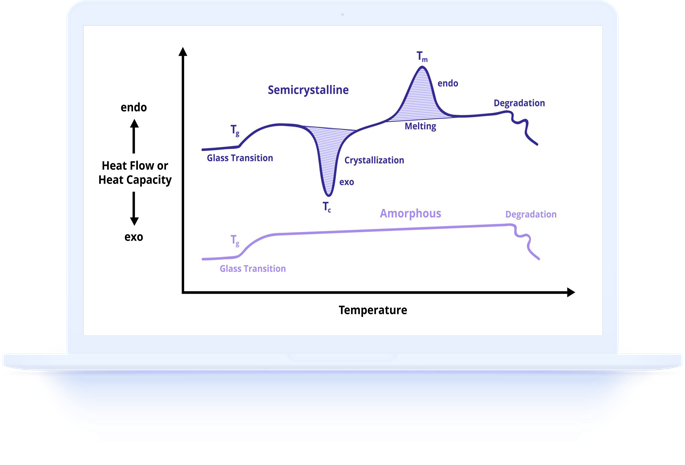
For the glass transition, DSC detects the step change in heat capacity as polymer chains gain mobility, while DMA detects the dramatic drop in storage modulus and the peak in tan delta that accompany the softening of the material. The Tg values obtained by the two techniques typically differ by several degrees due to the different physical properties being measured.
DSC excels at measuring transition temperatures, enthalpies, and heat capacities. DMA excels at measuring temperature-dependent mechanical properties, frequency effects, and damping behavior. Each technique provides unique information that the other cannot easily obtain.
Comparing Tg Values: DSC vs DMA
The glass transition temperature measured by DSC and DMA often differs because the two techniques measure different manifestations of the same molecular relaxation process. DSC Tg is based on the midpoint of the heat capacity step change, while DMA Tg can be reported from the onset of storage modulus decline, the peak of loss modulus, or the peak of tan delta.
DMA tan delta peak Tg values are typically 10 to 25 degrees Celsius higher than DSC midpoint Tg values for the same material. The DMA loss modulus peak gives values closer to the DSC Tg but still usually slightly higher. These systematic differences must be understood when comparing data from different techniques or when specifications reference a specific measurement method.
Neither technique gives the correct Tg; rather, each gives a valid measurement of a specific aspect of the glass transition process. Specifications should always state which technique and which reporting convention defines the required Tg value.
When to Use DSC vs DMA vs Both
Choose DSC when you need thermal transition temperatures, enthalpies, heat capacity, crystallinity, purity, or cure state. Choose DMA when you need temperature-dependent modulus data, damping properties, frequency-dependent behavior, or the most sensitive detection of weak transitions.
For glass transition temperature measurement, DSC is faster, requires less sample, and is sufficient for most routine applications. DMA provides higher sensitivity for detecting weak glass transitions in highly crystalline or heavily filled materials and gives additional information about the width and nature of the transition.
For many applications, using both techniques provides the most complete characterization. DSC gives the thermal properties, while DMA gives the mechanical properties, and together they fully describe the material’s behavior across its temperature range.
Cost and Practical Considerations
From a practical standpoint, DSC testing is generally faster, less expensive, and requires smaller samples than DMA. A DSC measurement can be completed in 30 to 60 minutes with 5 to 15 milligrams of sample in any physical form (powder, film, chunk, fiber). DMA requires carefully prepared rectangular specimens and measurements may take several hours.
DSC instruments are more widely available in testing laboratories, and the technique has a lower barrier to entry in terms of operator training and sample preparation. DMA instruments are more specialized and typically found in materials research and polymer characterization laboratories.
For routine quality control and material screening, DSC is usually the technique of choice due to its speed, simplicity, and versatility. DMA is deployed when the specific information it provides (modulus vs temperature, damping) is needed for design, specification, or advanced characterization purposes.
Comprehensive Thermal and Mechanical Testing
Our laboratory offers both DSC and DMA testing services, allowing comprehensive thermal and mechanical characterization from a single source. We can recommend the appropriate technique or combination of techniques based on your material type and the information you need.
Contact us to discuss whether DSC, DMA, or both are appropriate for your characterization needs, and receive a quotation covering the recommended testing program.
