
DSC Testing for Rubber and Elastomers: A Complete Guide
DSC Testing for Rubber and Elastomers: A Complete Guide
 DSC Test
DSC Testing for Rubber and Elastomers: A Complete Guide
Why DSC Is Essential for Rubber Analysis
Rubber and elastomer materials exhibit unique thermal behavior that makes DSC an invaluable characterization tool for compounders, manufacturers, and quality control laboratories. Unlike rigid plastics, rubbers are used specifically for their flexibility and elasticity, properties that are directly related to their thermal characteristics.
The glass transition temperature of a rubber compound determines its low-temperature flexibility and service range. A tire rubber compound, for example, must maintain flexibility at winter temperatures, making accurate Tg measurement critical for formulation development. DSC provides the fastest and most reliable method for measuring this essential property.
Beyond Tg measurement, DSC reveals information about vulcanization state, oil and plasticizer content, blend composition, and thermal stability. A single DSC scan of a rubber sample can provide a comprehensive thermal fingerprint that identifies the material type, confirms proper processing, and detects potential quality issues.
Measuring Glass Transition in Rubber Compounds
Glass transition temperature measurement in rubbers follows the same general principles as other polymers, but with some important practical considerations. Most rubber Tg values fall in the sub-ambient range, from minus 120 degrees Celsius for silicone rubbers to around minus 20 degrees Celsius for some nitrile rubbers, requiring DSC instruments equipped with mechanical cooling systems or liquid nitrogen cooling.
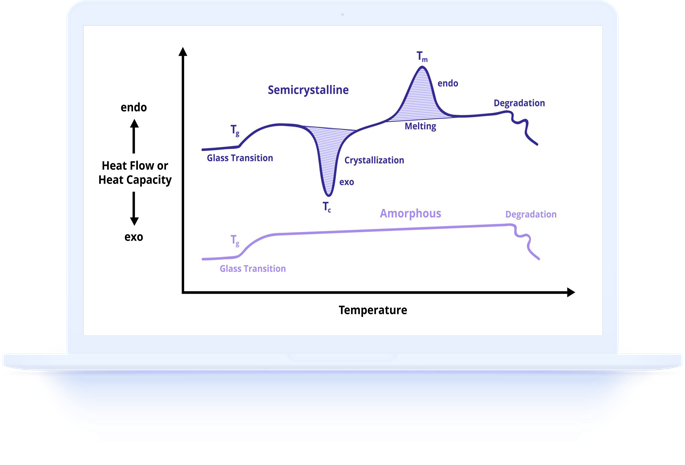
The DSC method for rubber Tg measurement involves cooling the sample well below the expected Tg, then heating at a controlled rate (typically 10 or 20 degrees per minute) while recording the heat flow signal. The glass transition appears as a step change in the baseline, and the midpoint of this step is reported as the Tg value.
For rubber blends and compounds containing multiple elastomer phases, DSC can detect separate glass transitions for each phase, providing information about blend composition and compatibility. An incompatible blend of natural rubber and nitrile rubber, for instance, would show two distinct Tg steps corresponding to the two polymer phases.
Vulcanization and Curing Studies by DSC
DSC provides powerful insights into the vulcanization process, the chemical cross-linking reaction that transforms soft, sticky raw rubber into a strong, elastic material. By measuring the exothermic heat generated during vulcanization, DSC characterizes the cure reaction and helps optimize processing conditions.
In a dynamic DSC scan, the vulcanization exotherm appears as a broad peak at elevated temperatures. The onset temperature indicates when cross-linking begins, the peak temperature shows where the reaction rate is highest, and the total area under the peak represents the total heat of vulcanization, which correlates with the degree of cross-linking achieved.
Isothermal DSC measurements at a fixed vulcanization temperature provide time-dependent cure information analogous to moving die rheometer (MDR) data. By measuring the rate of heat evolution over time, DSC determines the scorch time, optimum cure time, and degree of cure, all essential parameters for production optimization.
Cure Kinetics and Optimization
Cure kinetics studies using DSC determine the activation energy, reaction order, and rate constants of the vulcanization reaction. This information is valuable for predicting cure behavior at different temperatures and for developing optimal cure cycles that minimize cycle time while ensuring complete cross-linking.
The most common approach involves running DSC scans at multiple heating rates (for example, 2, 5, 10, and 20 degrees per minute) and analyzing the shift in peak temperature using methods such as the Kissinger or Ozawa-Flynn-Wall equations. These model-free kinetic methods provide activation energy values without assuming a specific reaction mechanism.
Advanced cure kinetics modeling can predict cure profiles under complex temperature programs encountered in actual manufacturing processes, such as thick rubber parts where temperature gradients cause different cure states at different locations within the part.
Identifying Rubber Types with DSC
DSC serves as a rapid identification tool for rubber materials, providing a thermal fingerprint that can distinguish between different elastomer types. Each rubber family has a characteristic glass transition temperature range and thermal behavior pattern that allows experienced analysts to identify unknown samples.
Natural rubber (NR) shows a Tg around minus 62 degrees Celsius. Styrene-butadiene rubber (SBR) has a Tg near minus 50 degrees Celsius. Nitrile rubber (NBR) ranges from minus 45 to minus 20 degrees Celsius depending on acrylonitrile content. Silicone rubber (VMQ) shows an extremely low Tg around minus 120 degrees Celsius. These distinctive values make rubber identification by DSC fast and reliable.
Beyond the glass transition, DSC can detect plasticizer evaporation, filler content, and residual cure exotherms that provide additional information about the rubber formulation and processing history. This comprehensive thermal profile helps troubleshoot quality problems and verify that incoming materials match specifications.
Aging and Degradation Analysis
DSC is widely used to assess the effects of thermal aging, ozone exposure, and chemical degradation on rubber properties. By comparing the thermal behavior of aged and unaged samples, analysts can quantify changes in cross-link density, detect chain scission or additional cross-linking, and predict remaining service life.
Thermal aging causes changes in the glass transition temperature and the shape of the transition that correlate with changes in mechanical properties. An increase in Tg typically indicates additional cross-linking (hardening), while a decrease may indicate chain scission or plasticizer loss. Monitoring these changes through accelerated aging studies helps engineers establish service life estimates.
Residual cure measurements on aged samples reveal whether the original vulcanization was complete. Under-cured rubber continues to cross-link during service, causing hardening and eventual brittleness. DSC can detect this residual cure exotherm and quantify the degree of under-cure, helping identify root causes of premature failure.
Industry Standards for Rubber DSC Testing
Several ASTM and ISO standards govern DSC testing of rubber and elastomer materials. ASTM D3418 covers the general methodology for measuring transition temperatures and enthalpies by DSC and is widely applied to rubber materials. ASTM E1356 specifically addresses glass transition temperature determination.
ISO 22768 provides a standardized method for determining the glass transition temperature of rubber materials using DSC, including specific requirements for sample preparation, heating rates, and data reporting. This standard is increasingly referenced in specifications for automotive and industrial rubber components.
For vulcanization studies, ASTM D6375 describes the use of DSC for determining cure characteristics of rubber compounds, complementing the traditional moving die rheometer methods specified in ASTM D5289. Using DSC for cure studies offers advantages in terms of smaller sample size and the ability to test actual production compounds.
Professional Rubber DSC Testing Services
Professional rubber DSC testing services provide manufacturers and end-users with reliable thermal characterization data for quality control, material selection, and failure analysis. Service laboratories maintain instruments calibrated for sub-ambient operation and employ analysts experienced in rubber thermal analysis.
Common rubber testing services include glass transition temperature measurement for compound identification and quality verification, vulcanization studies for cure optimization, competitive analysis and reverse engineering of competitor compounds, and failure investigation of rubber parts that have cracked, hardened, or lost elasticity.
Contact our testing laboratory for a consultation about your rubber and elastomer DSC testing needs. We offer standard turnaround and rush services for all common rubber testing applications.
