
DSC Testing for Plastics: Identification, Quality Control, and Failure Analysis
DSC Testing for Plastics: Identification, Quality Control, and Failure Analysis
 DSC Test
DSC Testing for Plastics: Identification, Quality Control, and Failure Analysis
Why Plastics Manufacturers Rely on DSC
Plastics manufacturers depend on DSC as their primary thermal analysis tool for quality control, material development, and troubleshooting. The technique’s ability to rapidly identify plastic materials, verify processing conditions, and detect quality issues makes it indispensable in modern plastics manufacturing.
A single DSC scan lasting 30 to 60 minutes reveals the glass transition temperature, melting point, crystallinity, thermal stability, and processing history of a plastic sample. This wealth of information from a few milligrams of material makes DSC the most efficient thermal characterization technique available for plastics testing.
Plastics processors use DSC data at every stage of the value chain: incoming material inspection of raw resins, in-process monitoring of part quality, outgoing quality verification of finished products, and root cause analysis of field failures. The technique helps ensure that the right material is being processed under the right conditions to produce parts that meet performance requirements.
Plastic Material Identification by DSC
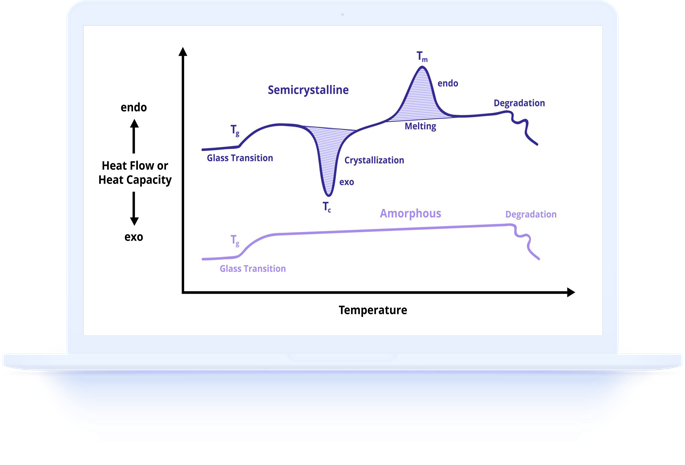
Plastic material identification by DSC relies on the unique thermal fingerprint that each polymer type exhibits. The melting temperature of a semi-crystalline plastic immediately narrows the identification to a small number of candidates, and the glass transition temperature further confirms the identification.
Polyethylene melts between 110 and 135 degrees Celsius depending on type and density. Polypropylene melts around 160 to 170 degrees Celsius. Nylon 6 melts near 220 degrees Celsius, while nylon 66 melts around 260 degrees Celsius. PET shows a melting point around 250 degrees Celsius. These well-known values make DSC a rapid identification tool.
For amorphous plastics that do not show melting peaks, the glass transition temperature serves as the primary identifier. Polystyrene has a Tg around 100 degrees Celsius, polycarbonate around 150 degrees, and polyetherimide around 215 degrees. Combined with any secondary thermal events, Tg provides reliable identification of amorphous polymers.
Incoming Material Quality Control
Incoming material quality control using DSC verifies that each lot of plastic resin meets specifications before it enters the manufacturing process. This proactive approach prevents production of defective parts from off-specification material and reduces waste, downtime, and customer complaints.
Key DSC parameters monitored in plastics QC include melting temperature and peak width (material identity and consistency), heat of fusion (crystallinity level), glass transition temperature (amorphous content and plasticizer level), and the presence of unexpected thermal events (contamination or degradation). Statistical process control methods applied to these parameters detect trends before they become problems.
Fast screening protocols can verify material identity in as little as 15 minutes using abbreviated DSC scans that focus on the critical melting or glass transition region. This enables 100 percent incoming lot inspection without creating a bottleneck in material handling.
Verifying Material Specifications
Material specifications for engineering plastics typically include DSC-measurable properties such as melting point range, glass transition temperature minimum, and crystallinity level or range. Meeting these specifications is essential for ensuring that molded or extruded parts perform as designed.
Specification limits are usually expressed as a nominal value plus tolerance, such as Tm = 165 plus or minus 5 degrees Celsius for polypropylene. The DSC test method (usually ASTM D3418 or ISO 11357-3) must be followed precisely to ensure that measured values are comparable to the specification values.
For critical applications in automotive, medical, and aerospace industries, material certificates of analysis routinely include DSC data. Suppliers provide DSC results for each production lot, and customers may perform verification testing on received material as part of their incoming quality program.
Failure Analysis Using DSC
DSC plays a valuable role in plastic part failure analysis by revealing thermal history information that relates to processing conditions and material condition. When a plastic part fails in service, DSC analysis of the failed part and comparison with properly performing parts often identifies the root cause.
Processing-related failures frequently show up as anomalies in the DSC curve. Under-cooling during injection molding produces lower crystallinity, visible as a reduced melting enthalpy. Over-heating during processing causes thermal degradation, detectable as shifts in melting temperature or the appearance of additional thermal events.
Wrong material usage, a common manufacturing error, is immediately apparent from DSC comparison. If a part specified as nylon 66 (Tm approximately 260 degrees Celsius) was accidentally molded from nylon 6 (Tm approximately 220 degrees Celsius), DSC unambiguously identifies the discrepancy. Similarly, contamination of one plastic with another produces multiple melting peaks that reveal the error.
Recycled vs Virgin Plastic Analysis
The growing use of recycled plastics creates additional quality control challenges that DSC helps address. Recycled resins may differ from virgin materials in crystallinity, thermal stability, and contamination levels, all of which DSC can detect and quantify.
Comparing DSC scans of recycled and virgin resins reveals differences in melting behavior, including broader melting peaks and slight temperature shifts that indicate molecular weight changes from reprocessing. The presence of contaminant polymers from imperfect sorting appears as additional melting peaks at unexpected temperatures.
Multiple reprocessing cycles progressively change polymer properties. DSC tracking of thermal properties through successive recycling passes helps establish maximum recycle content levels that maintain acceptable product performance. This data supports sustainability initiatives while ensuring product quality.
Plastics DSC Testing Services
Our plastics DSC testing laboratory serves manufacturers, processors, and end-users across all segments of the plastics industry. We provide rapid material identification, specification verification, quality control support, and failure analysis services.
Our plastics testing services include material identification by thermal fingerprinting, incoming quality control per ASTM D3418 and ISO 11357, crystallinity measurement, recycled content assessment, and failure analysis of defective parts. We maintain a comprehensive reference library of DSC data for common plastic materials to support identification work.
Contact us with your plastic material testing needs for a quotation and turnaround time estimate.
