
DSC Testing for Cosmetics and Personal Care Products
 DSC Test
DSC Testing for Cosmetics and Personal Care Products
Why Cosmetic Companies Use DSC Testing
The cosmetics and personal care industry uses DSC testing to understand the thermal behavior of ingredients and formulations, ensuring product quality, stability, and desired sensory properties. From lipstick to moisturizer, virtually every cosmetic product contains components whose thermal properties directly affect product performance.
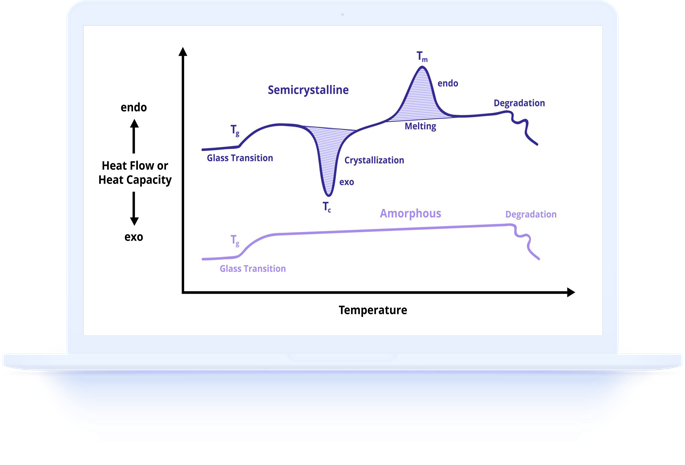
DSC reveals critical information about melting and solidification behavior of waxes and fats, polymorphic transitions in lipid-based products, compatibility between ingredients, and the thermal stability of active ingredients. This data helps formulators create products that maintain their structure, texture, and efficacy throughout their shelf life.
For quality control, DSC provides a rapid fingerprint of raw materials and finished products that can detect batch-to-batch variations, adulteration, or degradation without the need for complex chemical analysis. A single DSC scan takes less than an hour and requires only a few milligrams of sample.
Analyzing Waxes and Lipids by DSC
Waxes form the structural backbone of many cosmetic products including lipsticks, balms, mascara, and hair styling products. DSC precisely characterizes the melting behavior of individual waxes and wax blends, information that directly correlates with product hardness, application properties, and skin feel.
Natural waxes like beeswax, carnauba wax, and candelilla wax each show characteristic melting profiles in DSC that reflect their complex composition. Beeswax typically shows a broad melting range from approximately 62 to 65 degrees Celsius, while carnauba wax melts at a higher temperature around 82 to 86 degrees Celsius.
DSC analysis of wax blends reveals compatibility, eutectic behavior, and the effective melting range of the finished formulation. Formulators use this information to predict product hardness at various temperatures and to optimize wax combinations for specific applications such as tropical-proof lipsticks or temperature-sensitive balms.
Emulsion Stability Studies
Emulsion stability is a critical quality attribute for creams, lotions, and other emulsion-based cosmetic products. DSC provides unique insights into emulsion behavior by detecting the freezing and melting behavior of water within the emulsion structure, which relates directly to stability and shelf life.
In a stable oil-in-water emulsion, the water phase shows a characteristic freezing pattern that differs from bulk water. DSC can detect multiple freezing peaks corresponding to free water, loosely bound water, and tightly bound water within the emulsion structure. Changes in these peaks over time indicate destabilization.
Accelerated stability testing using DSC involves comparing the thermal profiles of fresh and aged emulsion samples. Coalescence, phase separation, or changes in the water binding state produce measurable differences in the DSC curves, often before visible changes are apparent. This makes DSC a sensitive early warning tool for emulsion instability.
Sunscreen and Active Ingredient Characterization
Active ingredients in cosmetic products, such as sunscreen filters, vitamins, and botanical extracts, must maintain their chemical identity and potency throughout the product’s shelf life. DSC helps characterize these ingredients and monitor their stability within formulations.
Sunscreen ingredients, particularly mineral filters like zinc oxide and titanium dioxide, and organic UV filters each have characteristic thermal profiles. DSC can verify the crystalline form of mineral sunscreen particles, which affects their UV absorption properties, and detect any polymorphic changes that might reduce efficacy.
Vitamin E (tocopherol), retinol, and other temperature-sensitive actives can be monitored by DSC for signs of degradation. Oxidation and decomposition reactions produce characteristic exothermic signals that indicate the onset of degradation, helping formulators determine whether their stabilization strategies are effective.
Quality Control in Cosmetic Manufacturing
Quality control in cosmetic manufacturing benefits from the speed and minimal sample requirements of DSC testing. Incoming raw material inspection using DSC provides a thermal fingerprint that can verify material identity and detect adulteration or degradation in seconds.
For wax-based products like lipsticks and balms, DSC provides a quantitative measure of hardness-related properties through the melting profile. Batch-to-batch consistency can be verified by overlaying DSC curves from production samples with approved reference curves. Any deviation in peak shape, temperature, or enthalpy flags potential quality issues.
Finished product testing by DSC can detect formulation errors such as incorrect wax ratios, wrong grade of raw material, or inadequate mixing. The technique complements traditional physical tests like drop point and penetration measurement, offering additional molecular-level information about product structure.
Regulatory Considerations for Cosmetic Testing
While specific DSC testing is not mandated by cosmetic regulations, the data it provides supports compliance with regulatory requirements for product stability, safety, and quality. Cosmetic regulatory frameworks including the EU Cosmetics Regulation, FDA guidelines, and ASEAN Cosmetic Directive all require manufacturers to demonstrate product stability and safety.
Stability testing protocols recommended by COLIPA (Cosmetics Europe) and the Personal Care Products Council include thermal stress testing where DSC data complements visual and physical assessments. DSC provides objective, quantitative evidence of product stability that strengthens regulatory dossiers.
For sunscreen products classified as over-the-counter drugs in the United States, the FDA requires extensive stability data. DSC analysis of sunscreen formulations provides evidence of physical stability and active ingredient integrity that supports drug registration applications.
Cosmetic DSC Testing Services
Our DSC testing services for the cosmetics and personal care industry cover the full range of applications from raw material characterization to finished product quality control. We work with formulators, manufacturers, and quality teams to provide thermal analysis data that supports product development and regulatory compliance.
Services include wax and lipid melting profile analysis, emulsion stability screening, active ingredient characterization, polymorphic form identification, and batch consistency verification. We can develop customized DSC protocols tailored to your specific products and quality requirements.
Contact our laboratory to discuss how DSC testing can support your cosmetic product development and quality assurance programs.
