
DSC Testing for Aerospace Materials: Ensuring Safety and Performance
DSC Testing for Aerospace Materials: Ensuring Safety and Performance
 DSC Test
DSC Testing for Aerospace Materials: Ensuring Safety and Performance
Why Aerospace Materials Demand Rigorous Thermal Testing
Aerospace materials operate under some of the most demanding conditions of any engineering application, including extreme temperature ranges, sustained mechanical loads, aggressive chemical environments, and the absolute requirement for structural reliability. DSC testing plays a critical role in qualifying materials for aerospace use and verifying that manufacturing processes produce components that meet stringent performance requirements.
Every structural material on an aircraft, from carbon fiber composite wing skins to titanium engine components to adhesive bond lines, must be characterized for its thermal behavior to ensure safe operation throughout the design life of the vehicle. DSC provides the thermal data that feeds into structural analysis, damage tolerance assessments, and maintenance planning.
The consequences of using inadequately characterized materials in aerospace applications can be catastrophic, which is why aerospace DSC testing follows rigorous standards and requires fully documented, traceable results from qualified laboratories.
DSC Applications in Aerospace Material Qualification
DSC supports aerospace material qualification at multiple stages. During material selection, DSC data helps engineers compare candidate materials and verify that thermal properties meet design requirements. During incoming quality inspection, DSC confirms that each lot of material conforms to the approved specification.
Process verification uses DSC to confirm that autoclave cure cycles, heat treatment processes, and bonding operations achieved the required thermal conditions. Post-cure glass transition temperature and residual cure measurements provide objective evidence of proper processing.
In-service monitoring programs use DSC to assess material condition after exposure to service environments. Samples removed from aging or retired aircraft structures are tested by DSC to verify that material properties remain within acceptable limits and to validate life prediction models.
Testing Composite Matrix Resins for Aircraft
Carbon fiber reinforced polymer (CFRP) composites are the most widely used structural composites in modern aircraft, and their matrix resin systems require thorough DSC characterization. Epoxy matrix resins used in aerospace composites must achieve glass transition temperatures typically above 177 degrees Celsius (wet) to maintain structural performance under operating conditions.
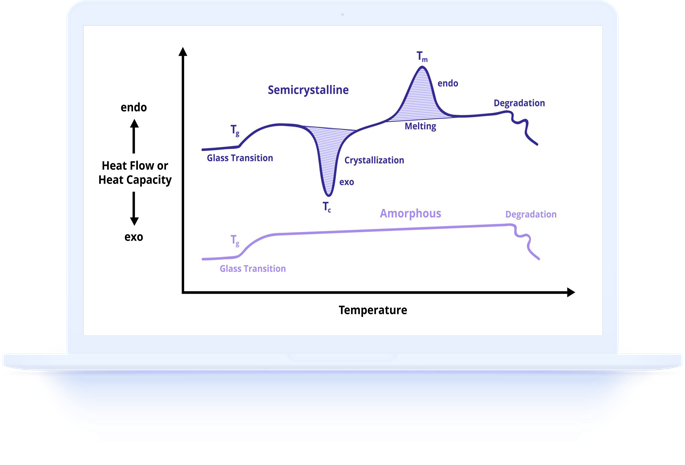
DSC testing of aerospace prepreg materials monitors resin advancement during storage, verifies the cure cycle window, and confirms post-cure Tg of fabricated laminates. These measurements are performed per specific airframe manufacturer requirements or industry standards such as ASTM D7028.
Repair materials and processes must also be qualified by DSC to ensure that field repairs achieve equivalent thermal properties to the original structure. DSC verification of repair patch cure state is a standard quality control step in both factory and field repair operations.
High-Temperature Alloy Characterization
While composites receive the most attention for aerospace DSC testing, metallic materials also benefit from thermal characterization. Aerospace alloys including titanium, nickel superalloys, and aluminum alloys undergo phase transformations during heat treatment that DSC can detect and characterize.
DSC measurements of precipitation and dissolution reactions in age-hardenable aluminum alloys help optimize heat treatment schedules for maximum strength. The technique detects the formation and dissolution of strengthening precipitates, providing information about the alloy’s metallurgical state.
Nickel-based superalloys used in turbine engines contain multiple phases whose formation and dissolution temperatures directly affect the alloy’s high-temperature strength. DSC mapping of these phase boundaries supports alloy development and heat treatment optimization.
Adhesive and Sealant Qualification by DSC
Structural adhesive bonding is extensively used in aerospace manufacturing, and the properties of the cured adhesive bond line directly affect structural integrity. DSC verifies that the adhesive cure cycle achieved adequate cross-linking by measuring glass transition temperature and confirming the absence of residual cure exotherm.
For co-bonded and secondary-bonded composite structures, DSC confirms that the adhesive’s Tg meets minimum requirements after curing with the thermal cycle used for the specific joint configuration. Different bond geometries may experience different thermal histories during manufacturing, and DSC verification ensures that all areas of the bondline are adequately cured.
Aerospace adhesive specifications from manufacturers like Henkel, 3M, and Cytec include DSC requirements for material qualification and quality control, making DSC testing a contractual requirement for adhesive-bonded structure production.
Aerospace Testing Standards and Specifications
Aerospace DSC testing follows a hierarchy of standards that includes international test methods (ASTM, ISO), industry specifications (SAE AMS, ARP), and individual airframe manufacturer requirements (Boeing, Airbus, Lockheed Martin). Each level may impose additional requirements beyond the base test method.
ASTM D7028 is the primary standard for DSC testing of polymer matrix composites in aerospace applications, specifying procedures for glass transition temperature measurement that meet the needs of major airframe and engine manufacturers.
Compliance with NADCAP (National Aerospace and Defense Contractors Accreditation Program) requirements may be necessary for laboratories providing DSC testing results that are referenced in aerospace certification documents.
Aerospace DSC Testing Services
Our laboratory provides aerospace-grade DSC testing services with full traceability, documented quality systems, and analysts experienced in the specific requirements of major airframe and engine manufacturers.
We perform prepreg characterization, cure verification, glass transition temperature measurement, and aging assessment per ASTM D7028 and customer-specific specifications. Contact us to discuss your aerospace testing needs.
