
DSC for Composite Materials: Fiber-Reinforced Polymers and Beyond
DSC for Composite Materials: Fiber-Reinforced Polymers and Beyond
 DSC Test
DSC for Composite Materials: Fiber-Reinforced Polymers and Beyond
Why DSC Is Critical for Composite Manufacturing
Composite materials, particularly fiber-reinforced polymers used in aerospace, automotive, and sporting goods applications, require rigorous thermal characterization to ensure manufacturing quality and in-service performance. The matrix resin in a composite determines many critical properties, and DSC provides the primary method for characterizing the resin’s thermal behavior.
The glass transition temperature of the cured matrix resin defines the maximum service temperature of the composite structure. If the operating temperature approaches Tg, the matrix softens dramatically, leading to catastrophic loss of compressive strength and stiffness. Accurate Tg measurement by DSC is therefore essential for structural design and material qualification.
DSC also monitors the degree of cure of the matrix resin, which must achieve specified minimum levels to ensure full development of mechanical properties. Under-cured composites exhibit lower Tg, reduced chemical resistance, and inferior long-term durability, making cure verification by DSC a critical quality control step.
Measuring Tg of Composite Matrix Resins
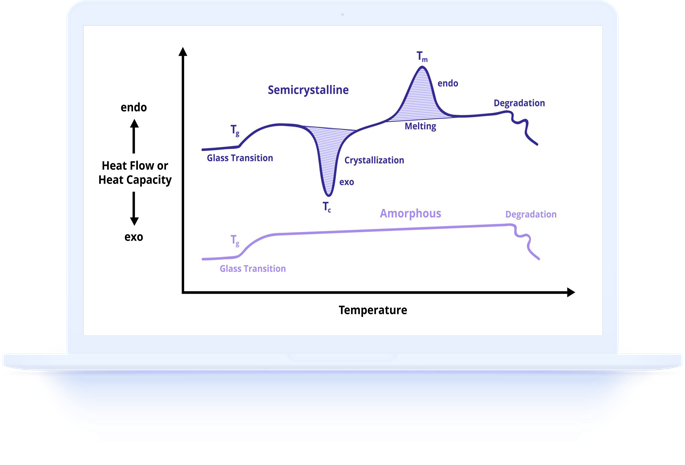
Glass transition temperature measurement of composite matrix resins follows the same DSC principles used for neat polymers, but with some practical considerations specific to fiber-reinforced materials. The fiber content reduces the resin fraction available for the Tg measurement, resulting in smaller step changes that may require larger sample masses or more sensitive instruments.
Typical composite matrix resin Tg values range from 120 degrees Celsius for standard-cure epoxies to over 350 degrees Celsius for high-temperature polyimide systems. Aerospace specifications typically require a minimum Tg measured by DSC, with values like 177 degrees Celsius (wet) or 200 degrees Celsius (dry) being common for structural applications.
Moisture absorption significantly reduces the Tg of epoxy-based composites, a phenomenon known as plasticization. For this reason, specifications often distinguish between dry Tg and wet Tg (measured after moisture conditioning), and both values may be required for material qualification.
Cure Monitoring for Prepregs and Adhesive Films
DSC cure monitoring of prepreg materials (pre-impregnated fiber reinforcements) ensures that the resin system is within its usable life and that the recommended cure cycle will produce fully cured laminates. Fresh prepreg shows a large cure exotherm, which decreases as the resin slowly advances during storage.
The residual cure enthalpy of prepreg material directly indicates its freshness and usability. Specifications typically establish minimum residual enthalpy values below which the material is considered out of life and must be discarded. Regular DSC testing of stored prepreg tracks this parameter and ensures that only usable material enters production.
After autoclave or oven curing, DSC verification of the cured laminate confirms that the cure cycle achieved adequate cross-linking. A fully cured composite shows no residual cure exotherm and exhibits a Tg at or above the minimum specification value. These two criteria provide confidence that the curing process was successful.
Quality Control of Incoming Composite Materials
Quality control of incoming composite materials involves DSC testing at multiple stages. Raw prepreg material is tested upon receipt to verify the resin’s thermal characteristics and confirm shelf life. Stored material is periodically retested to monitor cure advancement and ensure it remains within usable limits.
Cured composite test panels and production parts undergo DSC testing to verify the glass transition temperature and confirm the absence of residual cure exotherm. These measurements provide documented evidence that the cure cycle was properly executed and that the finished part meets material specifications.
For bonded composite structures, DSC testing of the adhesive bond line verifies that the adhesive reached full cure during the bonding cycle. Insufficient adhesive cure is a common defect that compromises structural integrity, and DSC provides the primary detection method.
Thermal Aging Assessment of Composites
Thermal aging of composite materials in service environments can cause changes in matrix properties that DSC detects and quantifies. Post-cure advancement increases Tg over time at elevated temperatures, while thermal oxidative degradation eventually causes Tg reduction and embrittlement.
Accelerated aging studies using DSC track changes in Tg and other thermal properties as a function of aging time and temperature. This data supports predictions of long-term property retention and helps establish inspection intervals and replacement schedules for composite structures in critical applications.
DSC analysis of composite samples removed from aging or service exposure provides direct evidence of the material’s current condition, complementing mechanical testing and visual inspection as part of a comprehensive structural health monitoring program.
Aerospace and Automotive Composite Standards
Aerospace composite testing follows stringent standards from organizations including ASTM, SAE, and individual airframe manufacturers. ASTM D7028 specifies DSC procedures for determining glass transition temperature of composite matrix resins, while various Airbus and Boeing specifications impose additional requirements for cure verification.
Automotive composite standards from SAE and ISO reference DSC methods for material qualification and production quality control. As automotive use of composites increases, particularly in electric vehicle battery enclosures and structural components, the demand for standardized DSC testing grows accordingly.
Our laboratory maintains qualification to perform composite DSC testing per major aerospace and automotive standards, with documented procedures and trained analysts experienced in the specific requirements of each specification.
Composite DSC Testing Services
Our composite materials DSC testing services support manufacturers, repair stations, and end-users across aerospace, automotive, marine, and industrial sectors. We provide incoming material qualification, cure verification, shelf-life monitoring, and aging assessment services.
Contact our laboratory for a consultation about your composite thermal analysis needs. We offer standard and expedited turnaround with full documentation suitable for aerospace quality records.
