
DSC Curing Analysis for Epoxy, Adhesives, and Thermoset Resins
DSC Curing Analysis for Epoxy, Adhesives, and Thermoset Resins
 DSC Test
DSC Curing Analysis for Epoxy, Adhesives, and Thermoset Resins
Understanding Curing Reactions in Thermosets
Thermoset materials, including epoxy resins, polyurethanes, phenolic resins, and unsaturated polyesters, undergo irreversible chemical cross-linking reactions during curing that transform them from liquid or semi-solid precursors into rigid, three-dimensional network structures. Understanding and controlling this curing process is essential for achieving optimal mechanical properties and performance.
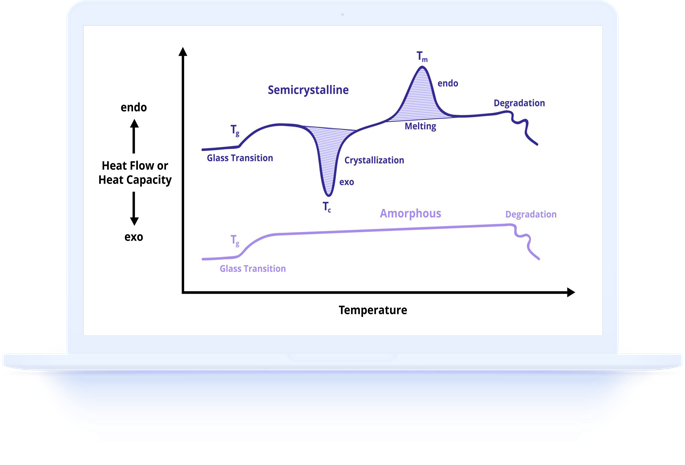
The curing reaction is exothermic, meaning it releases heat as chemical bonds form between reactive groups. DSC detects and quantifies this heat release, providing fundamental information about the cure reaction including its onset temperature, peak rate temperature, total enthalpy, and degree of completion.
Industrial applications of thermoset curing span a vast range, from structural adhesives in aircraft assembly to protective coatings on automotive parts to encapsulants in electronic components. In every case, proper curing directly determines the final properties and reliability of the finished product.
How DSC Measures Curing Behavior
DSC measures curing behavior by detecting the exothermic heat released during the cross-linking reaction. Two fundamental approaches are used: dynamic (scanning) and isothermal methods, each providing different but complementary information about the cure process.
In a dynamic DSC cure measurement, the uncured or partially cured sample is heated at a constant rate (typically 5 to 20 degrees per minute) through the curing temperature range. The resulting exotherm provides the onset temperature of cure, the temperature of maximum cure rate (peak temperature), and the total heat of reaction from integration of the peak area.
In isothermal DSC cure studies, the sample is rapidly heated to a fixed temperature and held there while the instrument monitors heat evolution over time. This approach directly simulates manufacturing conditions and provides time-dependent cure information including induction time, time to peak cure rate, and time to achieve various degrees of conversion.
Dynamic DSC Curing Scans
Dynamic DSC curing scans provide a quick overview of the cure reaction that is useful for material screening, comparing different formulations, and establishing the general temperature range over which curing occurs.
The onset temperature of the cure exotherm indicates the minimum temperature at which cross-linking begins at a detectable rate. This information is important for determining storage stability, processing windows, and the risk of premature curing during handling or preheating.
The peak temperature corresponds to the temperature of maximum reaction rate and shifts to higher temperatures as the heating rate increases. By running scans at multiple heating rates and analyzing the peak temperature shifts, kinetic parameters such as activation energy can be determined using methods like the Kissinger equation.
The total area under the dynamic cure exotherm represents the total enthalpy of the curing reaction, typically expressed in joules per gram. This value serves as the reference for calculating degree of cure in subsequent measurements of partially cured samples.
Isothermal Curing Studies
Isothermal DSC cure studies directly simulate the manufacturing cure cycle by holding the sample at a constant temperature representative of the actual process conditions. The resulting data shows the rate of cure as a function of time, providing information directly applicable to process optimization.
The isothermal cure curve shows an initial increase in heat flow as the reaction accelerates, reaches a maximum corresponding to the highest cure rate, and then gradually decreases as the reaction slows due to increasing cross-link density and vitrification. The total area under the curve gives the heat evolved at that specific cure temperature.
By running isothermal studies at several temperatures, a map of cure behavior across the processing range is constructed. Higher cure temperatures generally produce faster reactions but may cause thermal degradation if too high. Lower temperatures give more controlled reactions but longer cycle times. DSC data helps identify the optimal balance between cure speed and product quality.
Calculating Degree of Cure from DSC Data
The degree of cure, expressed as a percentage of the total cross-linking reaction completed, is calculated from DSC data by comparing the residual exotherm of a partially cured sample to the total reaction enthalpy of the uncured material.
The calculation is straightforward: Degree of Cure (percent) equals (1 minus residual enthalpy divided by total enthalpy) times 100. The total enthalpy is determined from a dynamic scan of uncured material, and the residual enthalpy comes from a dynamic scan of the partially cured sample.
Degree of cure directly correlates with mechanical properties. A cure of 95 percent or higher is typically required for optimal performance, as the last few percent of cure can have a disproportionate effect on properties like glass transition temperature, chemical resistance, and long-term durability. Under-cured products may fail prematurely due to lower cross-link density.
Optimizing Cure Cycles with DSC
DSC data enables systematic optimization of cure cycles to achieve the best balance between production speed, energy consumption, and product performance. By understanding how temperature affects cure rate and final properties, engineers can design efficient cure schedules that minimize cycle time while ensuring complete cross-linking.
A common optimization strategy involves a two-stage cure: an initial low-temperature stage that allows the resin to flow and wet surfaces before significant cross-linking occurs, followed by a higher-temperature stage that drives the cure reaction to completion. DSC isothermal and dynamic data at various temperatures guides the selection of temperatures and times for each stage.
For thick parts where temperature gradients cause different cure rates at different locations, DSC data feeds into cure simulation software that predicts the temperature and degree of cure throughout the part as a function of time. This modeling approach prevents problems like surface over-cure and core under-cure that can compromise part quality.
Cure Kinetics and Modeling
Cure kinetics analysis using DSC determines the mathematical relationship between cure rate, temperature, and degree of conversion. This information enables prediction of cure behavior under conditions different from those explicitly tested, greatly extending the value of a limited number of DSC measurements.
Model-free kinetic methods, such as the Kissinger and Ozawa-Flynn-Wall approaches, determine activation energy from the shift in peak temperature with heating rate in dynamic scans. These methods require minimal assumptions about the reaction mechanism and provide reliable activation energy values for most thermoset systems.
More advanced model-fitting approaches use isothermal or dynamic DSC data to determine the complete kinetic rate equation, including activation energy, pre-exponential factor, and reaction order or model function. These detailed models can be incorporated into finite element simulation software for predicting cure behavior in complex part geometries and processing conditions.
Professional Curing Analysis Services
Our laboratory provides comprehensive DSC curing analysis services for adhesive manufacturers, composite fabricators, coatings suppliers, and electronic packaging companies. We help optimize cure cycles, validate formulations, and troubleshoot processing problems using thermal analysis data.
Our curing services include dynamic cure characterization, isothermal cure studies at specified temperatures, degree of cure measurement for process validation, cure kinetics analysis, and glass transition temperature measurement to correlate with cure state. We test epoxies, polyurethanes, silicones, phenolics, and other thermoset systems.
Contact our technical team to discuss your curing analysis requirements and receive a detailed proposal.
